---
# AI-era reinvention of the transactional database with Sigmoid LatticeIQ
**URL:** https://www.sigmoid.com/blogs/ai-era-reinvention-of-the-transactional-database-with-sigmoid-latticeiq/
Date: 2026-07-02
Author: Joha Momin
Post Type: post
Summary: Key takeaways Sigmoid LatticeIQ unifies transactional databases, lakehouse analytics, and generative AI into a single governed architecture. Native synchronization and change data...Read More...
Categories: Data Management
Tags: Agentic AI, AI Agents, AI/ML, Data Management, Databricks
Featured Image: https://www.sigmoid.com/wp-content/uploads/2026/07/[email protected]
---
## Key takeaways
- Sigmoid LatticeIQ unifies transactional databases, lakehouse analytics, and generative AI into a single governed architecture.
- Native synchronization and change data capture enable live data availability to power real-time AI applications.
- Built on Databricks Lakebase, Sigmoid LatticeIQ combines sub-10ms query performance, serverless autoscaling, and unified governance through Unity Catalog.
- Sigmoid LatticeIQ provides the live, governed data foundation required for enterprise AI and intelligent automation.
- By consolidating transactions, analytics, and AI on a single platform, organizations reduce operational complexity.
For years, enterprise leaders in Consumer Packaged Goods (CPG), Life Sciences, and Financial Services have tolerated a silent tax on their data architecture: the fatal disconnect between operational action (OLTP), deep analysis (OLAP), and intelligent activation (GenAI). Valuable context has historically lived fractured across distinct transactional databases, analytics platforms, and isolated domain models.
The cost of maintaining this "Fragmented Citadel" is high, fragile custom ETL pipelines, compounding dual-governance liabilities, and a brutal 24-48 hour latency gap that completely paralyzes real-time decision-making.
## Enter the liquid data matrix
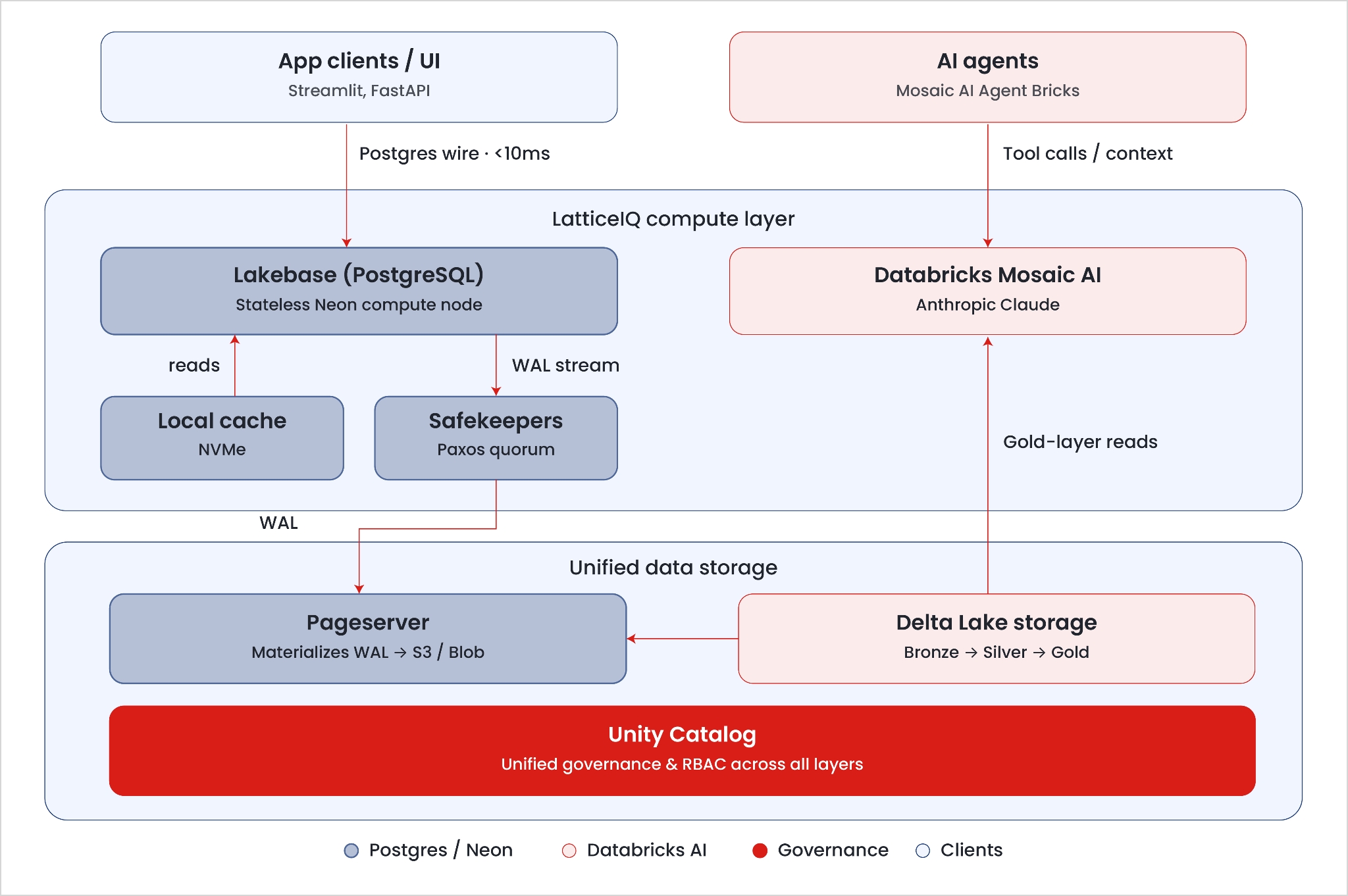
Sigmoid LatticeIQ, built natively on Databricks Lakebase, completely bridges this structural divide. Databricks Lakebase introduces an entirely new product category, a fully managed, serverless PostgreSQL database that stores data directly in cloud object storage in open Delta Lake format, breaking compute away from storage at the Write-Ahead Log (WAL) boundary.
By leveraging this foundational engine, Sigmoid LatticeIQ unifies transactional database speed, analytical lakehouse computing, and domain-specific generative intelligence into a singular architectural matrix. It entirely eradicates data sync lag, utilizes Unity Catalog for a single access-control plane, and scales compute to zero when idle to deliver unprecedented performance and cost efficiency.
## Core capabilities & enterprise value
The architectural advantage of Sigmoid LatticeIQ is not built around a single feature. It comes from combining transactional performance, analytical scale, and AI readiness within one governed platform for enterprise AI analytics. The following capabilities show how this unified design reduces data movement, accelerates application responsiveness, and lowers infrastructure costs.
### 1. Zero-copy architecture & bidirectional sync
Traditional, manual, cross-system ETL pipelines are entirely eliminated. Through Lakebase Synced Tables, analytical gold-layer metrics are natively replicated to Lakebase as read-only Postgres tables for application access. Concurrently, Moonlink CDC streams operational transactions and updates from the application layer back into Delta Lake in real time.
Value: This architecture completely cuts the 24-to-48-hour latency gap down to sub-seconds, ensuring that AI agents and business teams make decisions using live data without engineering overhead.
### 2. Sub-10ms UI query latency at scale
The architecture combines stateless PostgreSQL compute nodes with a local NVMe SSD Local File Cache (LFC). This configuration smoothly handles heavy, concurrent transactional read-and-write workloads.
Value: It ensures an interactive, ultra-responsive user experience for complex frontline business systems (such as real-time scenario planners and S&OP forecasting dashboards) even under massive concurrency.
### 3. Serverless autoscaling with scale-to-zero economics
The decoupled PostgreSQL compute layer functions as an ephemeral service. Compute adjusts dynamically to workload demand—scaling up for bursts and shutting off entirely to true zero when completely idle.
Value: This eliminates the financial burden of keeping traditional "always-on" cloud database instances running, making periodic or unpredictable analytical workloads immensely cost-effective.
### 4. Instant, risk-free database branching
Sigmoid LatticeIQ uses metadata pointers and copy-on-write capabilities to clone an existing production database in seconds. Because it is a pointer-based operation, no data is copied and actual storage blocks are never duplicated until modified.
Value: This empowers data scientists and engineers to run isolated, risk-free econometric model simulations, safe schema migrations, and sandbox testing using real-world production context without affecting live applications.
### 5. Unified governance plane under unity catalog
The entire operational database registers directly as a Unity Catalog resource. This deployment applies identical security protocols across the entire data ecosystem.
Value: It simplifies compliance auditing by enforcing the exact same role-based access controls (RBAC), data lineage tracking, and row-and-column-level masking rules to operational tables, data lake assets, and GenAI contexts all at once.
### 6. Full open-source PostgreSQL compatibility
The engine operates natively on unmodified PostgreSQL (v16 and v17) wire protocols. It provides out-of-the-box support for over 52 extensions, including pgvector for AI vector embeddings.
Value: It accelerates developer velocity and time-to-market, allowing existing applications (built with Django, SQLAlchemy, or FastAPI) to migrate seamlessly to this high-performance framework simply by updating connection strings—requiring zero application code rewrites.
## Production spotlights: Real-world implementations
Most organizations still operate with separate systems for transactions, analytics, and AI, forcing data to move through multiple pipelines before it becomes actionable. Sigmoid LatticeIQ removes these boundaries by combining operational database performance, lakehouse analytics, and AI-ready serving within a single governed architecture.
### Spotlight 1: Marketing budget optimization
The Friction: A global beverage enterprise ran an all-in-one Advertising & Promotion (A&P) allocation platform across countries and brands. Its transactional databases were hosted on Azure PostgreSQL Flexible Server, a standalone service entirely separate from the Databricks platform where its core analytics, econometric modeling, and GenAI workloads ran. The platform operations team did not support PostgreSQL, the codebase was migrating to Spark on Databricks, and the setup required custom connectors to shuffle data back and forth.
The Shift: The legacy databases were migrated directly to Sigmoid LatticeIQ. This simple transition brought the platform's transactional layer under the unified Databricks platform and governance plane, completely eliminating the custom ETL bridge. Optimisation outputs, scenario configs, and processed sales data now flow through a single, clean architecture.
The Verdict: Lakebase scored a perfect 5/5 across Time, Strategic Alignment, and Requirements (compared to Azure PostgreSQL's 3/5) by delivering native platform alignment, serverless autoscaling for burst queries, and copy-on-write branching for risk-free testing of new econometric model versions against live data.
### Spotlight 2: Consumer Data Platform (CDP) and digital media activation
The Friction: A leading CPG enterprise needed a Consumer Data Platform unifying 360° consumer profiles across offline, D2C, and social channels. However, operational consumer profile data lived in a separate OLTP system, while analytical models ran on Databricks. Keeping the two in sync required custom ETL pipelines, introduced a painful 24-48 hour latency gap between insights and activation, and created dual governance overhead for identical consumer records.
The Shift: Sigmoid LatticeIQ was deployed as the operational serving layer for the CDP. Aggregated consumer records and ML-scored audience segments are synced into Lakebase via Synced Tables, enabling frontline marketing dashboards to query fresh profiles at sub-10ms latency. Simultaneously, Moonlink CDC streams real-time purchase and engagement events from the application layer straight back to the lakehouse for continuous model retraining.
The Verdict: Sigmoid LatticeIQ successfully replaced two bespoke pipelines with a single governed, always-fresh data flow. This single architecture safely processed over 1M+ unique records, achieved a 92% profile accuracy rate, drove a 30% increase in data coverage, and unlocked a 3x improvement in marketing ROI within a tight 16-to-20-week delivery window.
### Spotlight 3: Agentic S&OP forecasting
The Friction: A premium FMCG enterprise built an Agentic AI solution for Supply & Operations to detect forecast anomalies, compute ML reliability scores, and generate LLM-driven narrative explanations through an interactive Streamlit dashboard. However, querying raw Delta tables directly from the UI for every single analyst interaction introduced unacceptable latency, while a separate operational database would have required a new, lag-heavy ETL pipeline.
The Shift: Sigmoid LatticeIQ was positioned as the interactive operational serving layer between the Gold Delta tables and the application backend (deployed via Databricks Apps). While weekly Databricks Workflow jobs refresh metrics and execute LLM summarization via Databricks Mosaic AI (using Anthropic Claude), the Streamlit UI queries Sigmoid LatticeIQ via standard Postgres SQL for instant response. Mosaic AI Agent Bricks handle real-time tool-calling and reasoning over the live operational tables.
The Verdict: Because Lakebase tables are backed by Delta Lake, the Gold-to-Serving write is a native lakehouse operation rather than a cross-system ETL job. The system delivered a spectacular sub-10ms UI query latency and leveraged scale-to-zero compute to keep the pilot phase exceptionally cost-effective, completing the entire journey from pilot to production in just 13 weeks.
## The decision framework: Citadel vs. Matrix
Friction Pillar
Fragmented Citadel (Split Stack)
Liquid Matrix (Sigmoid LatticeIQ)
Data Freshness
High Friction: 24–48 hour ETL lag.
Low Friction:
---
## Categories
- Data Management
---
## Navigation
- [Company](/about-sigmoid)
- [Newsroom](/newsroom)
- [Life at Sigmoid](/careers)
- [Takshashila](/takshashila)
- [Contact Us](/contact-us)
- [AI Strategy Blueprint your AI advantage](/enterprise-ai-strategy/)
- [Generative AI Drive innovation with Generative AI](/generative-ai/)
- [Responsible AI Build trust with ethical AI practices](/responsible-ai-in-enterprise/)
- [Agentic AI Reshape business with scalable agentic systems](/agentic-ai-solutions/)
- [AI Managed Services Ensure reliable AI performance](/ai-managed-services/)
- [Advanced Analytics Transform your business with data-driven insights](/advanced-data-analytics-solutions/)
- [Download whitepaper](/ebooks-whitepapers/the-new-qsr-playbook-transforming-menu-strategy-into-a-growth-engine/)
- [Data Strategy Strong data foundations for scalable AI](/data-analytics-strategy/)
- [Data Management Leverage data as a strategic asset](/ai-data-management-services/)
- [DataOps Automate data for speed and quality](/data-devops/)
- [Forward Deployed Engineering Scale enterprise AI with FDEs & specialized agents](/forward-deployed-engineering/)
- [Data Engineering Deliver insights faster with scalable pipelines](/data-engineering/)
- [Cloud Transformation Modernize data to maximise efficiency](/cloud-migration/)
- [Download whitepaper](/ebooks-whitepapers/building-data-products-in-a-data-mesh-to-drive-business-value/)
- [Data Modeling Structure data for better decisions](/data-modeling-services/)
- [Data Visualization Transform data into actionable stories](/data-visualization-service/)
- [BI Migration Enhance decision making with modern BI tools](/bi-migration/)
- [Data Observability Build trust with healthy, accurate data](/data-observability/)
- [Automated Insights Make smarter decisions with auto-generated insights](/automated-insights/)
- [Download whitepaper](/ebooks-whitepapers/how-cognitive-bi-drives-an-intelligent-enterprise/)
- [CPG & Retail End-to-end analytics for planning, operations, and commercial excellence](/industries/cpg-analytics/)
- [Life Sciences Trusted intelligence across clinical, commercial, and operational workflows](/industries/life-sciences/)
- [Banking & Financial Services AI-powered analytics for risk, compliance and customer experience](/industries/banking-financial-analytics-services/)
- [Insurance Modernize core insurance platforms and unlock new revenue streams with AI](/industries/insurance-reimagined-with-ai/)
- [Download infographic](/wp-content/uploads/2026/03/Infographic_Maturity-Framework-for-Scaling-Agentic-AI.pdf)
- [Helios Turn marketing data into measurable business outcomes](/marketing-suite-helios/)
- [Stratos AI-powered platform for resilient supply chains](/supply-chain-stratos/)
- [DataGuard Agentic AI platform for data quality and governance](/data-quality-dataguard/)
- [MediaIQ Advanced platform for in-flight marketing measurement](/accelerators/sigmoid-mediaiq-multi-touch-attribution-tool/)
- [CampaignIQ AI-driven platform for optimized campaign budget allocation](/accelerators/sigmoid-campaigniq/)
- [AssistBot GenAI email assistant that automates human-like responses](/accelerators/sigmoid-assistbot-for-ai-email-assistant/)
- [CreativeBot GenAI tool for personalized and brand-aligned creative design](/accelerators/sigmoid-creativebot/)
- [SocialBot GenAI platform to analyze digital conversations and trends](/accelerators/#marketing|socialbot)
- [DemandIQ Predict trends accurately and optimize inventory management](/accelerators/sigmoid-demandiq/)
- [NetworkIQ Track and optimize logistics operations in real-time to quickly address disruptions](/accelerators/sigmoid-networkiq/)
- [SupplyIQ End-to-end platform to optimize supply chain operations](/accelerators/sigmoid-supplyiq/)
- [ProcurementIQ Automated procurement operations for maximum savings, compliance and efficiency](/accelerators/sigmoid-procurementiq/)
- [RapidML Accelerated deployment for machine learning models](/accelerators/sigmoid-rapidml/)
- [DataGuard Comprehensive platform for proactive data quality management](/accelerators/data-quality-tool-sigmoid-dataguard/)
- [CloudPulse Cloud cost optimization platform with multi-cloud management](/accelerators/sigmoid-cloudpulse/)
- [RAPID GenAI foundation with built-in governance and cost clarity](/accelerators/sigmoid-rapid/)
- [AnalyticsBot Conversational analytics for faster business decisions](/accelerators/sigmoid-analyticsbot/)
- [DataConnect Seamlessly ingest, integrate and harmonize data from diverse sources](/accelerators/sigmoid-dataconnect/)
- [Reconica AI-powered data harmonization and reconciliation engine](/accelerators/sigmoid-reconica/)
- [ConverseBot GenAI driven insights generation for automated insights from reports](/accelerators/#sales|conversebot)
- [iNRM Cross-lever revenue growth optimization platform](/accelerators/sigmoid-inrm/)
- [AssortmentIQ Optimize shelf layouts and assortment mix at scale with AI-based insights](/accelerators/sigmoid-assortmentiq/)
- [Read whitepaper](/ebooks-whitepapers/building-agentic-ai-chatbots-for-business-process-transformation/)
- [Listen Podcast](/events/podcast/how-jack-in-the-box-is-redefining-personalization-and-supply-chain-with-ai/)
- [Blogs](/blogs/)
- [White Papers](/ebooks-whitepapers/)
- [Case Studies](/case-studies/)
- [Podcast](/events/podcast/#Podcasts)
- [Download case study](/case-studies/ai-based-dynamic-targeting-and-personalized-hcp-engagement-for-pharma-marketing/)
- [ConverseBot](/accelerators/#sales|conversebot/)
## Tags
- Agentic AI
- AI Agents
- AI/ML
- Data Management
- Databricks
---
## Footer Links
- [Talk to our AI experts](/contact-us/)
- [AI Strategy](/enterprise-ai-strategy/)
- [Agentic AI](/agentic-ai-solutions/)
- [Generative AI](/generative-ai/)
- [AI Managed Services](/ai-managed-services/)
- [Responsible AI](/responsible-ai-in-enterprise/)
- [Advanced Analytics](/advanced-data-analytics-solutions/)
- [Data Strategy](/data-analytics-strategy//)
- [Data Engineering](/data-engineering/)
- [Data Management](/ai-data-management-services/)
- [Cloud Transformation](/cloud-transformation/)
- [DataOps](/data-devops/)
- [Forward Deployed Engineering](/forward-deployed-engineering/)
- [Data Visualization](/data-visualization-service/)
- [Automated Insights](/automated-insights/)
- [BI Migration](/bi-migration/)
- [Data Modeling](/data-modeling-services/)
- [Data Observability](/data-observability/)
- [CPG & Retail](/industries/cpg-analytics/)
- [Life Sciences](/industries/life-sciences/)
- [Banking & Financial Services](/industries/banking-financial-analytics-services/)
- [Insurance](/industries/insurance-reimagined-with-ai/)
- [Case Studies](/case-studies/)
- [Thought Leadership](/ebooks-whitepapers/)
- [Blogs](/blogs/)
- [Helios](/marketing-suite-helios/)
- [Stratos](/supply-chain-stratos/)
- [DataGuard](/data-quality-dataguard/)
- [Company](/about-sigmoid/)
- [Newsroom](/newsroom/)
- [Accelerators](/accelerators/)
- [Careers](/careers/)
- [Privacy Policy |](/privacy-policy/)
- [Cookie Policy](/cookie-policy/)