---
# From stateless to personal: How memory powers trustworthy Agentic AI
**URL:** https://www.sigmoid.com/blogs/from-stateless-to-personal-how-memory-powers-trustworthy-agentic-ai/
Date: 2026-07-23
Author: Joha Momin
Post Type: post
Summary: Key takeaways Assistants without memory force users to repeat preferences and context in every session, a friction cost that directly undercuts the...Read More...
Categories: AI/ML
Tags: Agentic AI, AI Agents, GenAI, LLMOps, Personalization
Featured Image: https://www.sigmoid.com/wp-content/uploads/2026/07/From-stateless-to-personal-How-memory-powers-trustworthy-Agentic-AI-1.jpg
---
## Key takeaways
- Assistants without memory force users to repeat preferences and context in every session, a friction cost that directly undercuts the personalization enterprises expect from agentic AI.
- Memory isn't the agent's reasoning engine. It's the personalization layer that connects what a user has already told the system with what it needs to do right now.
- Reliable memory draws on four distinct types: semantic, episodic, procedural, and meta, each answering a different question about the user.
- Chat history is not memory. Conversations must be turned into structured, reusable signals, or they add noise instead of intelligence.
- Memory only builds trust when it's managed with discipline: kept selective, made visible to the user, and handled with privacy in mind.
Picture this: you invest real effort teaching your new AI assistant exactly how you work. Short emails. Clear priorities. Mandatory approval before anything is sent. Two days later, none of it seems to matter. The assistant asks the same basic questions all over again, as if your first conversation never happened.
Multiply that across an enterprise rolling out [agentic AI services](/agentic-ai-solutions/), and the pattern stops being an isolated inconvenience and becomes a business problem. Employees keep re-explaining context that should already exist. Assistants reason brilliantly in the moment but carry nothing forward into the next one. Teams end up training the same system over and over, one conversation at a time, with no compounding return on any of it.
What's missing isn't a smarter model; it's a system that remembers, one that carries context, preferences, and decisions forward the way a capable colleague would. That's the gap memory is built to close, and it's what this blog explores: why agents still behave statelessly, what memory contributes to personalization, the types of memory that make it work, and the discipline it takes to keep it useful rather than invasive.
## Why even the smartest agents still behave statelessly
Modern assistants are genuinely capable within a single conversation: summarizing, drafting, reasoning through complex requests. The problem isn't intelligence; it's continuity.
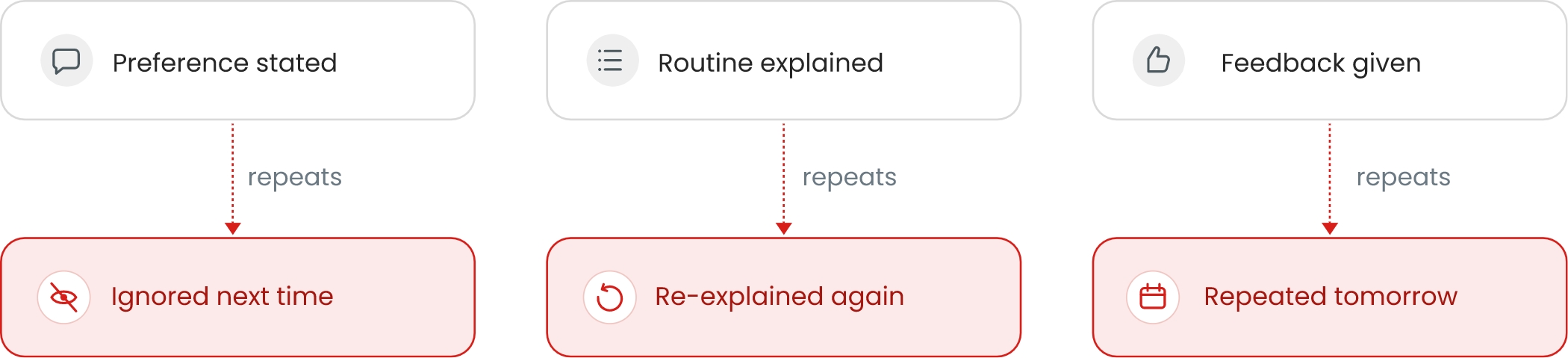
The gap usually comes down to one of two failures:
- Write failure: a signal never gets written down properly; a preference gets said out loud but disappears into a chat transcript, so the assistant has no reliable way to reuse it later.
- Read failure: the preference may already be on record, but never gets read back at the moment it matters, so the assistant only looks at what’s in front of it and asks again.
Either way, the person feels the same friction: questions that should never have needed to be asked twice. A smart assistant or agent can answer well. A memory-powered one can pick up exactly where things were left off, and that's what separates a demo from a system people actually rely on.
## Memory as the personalization layer
Memory doesn’t make an assistant smarter; it makes it personal. Strip it away, and an agent reacts only to what's in front of it right now. Add it back, and it draws on everything relevant that came before: preferences, past decisions, routines, unfinished work.
Let’s look at two examples that establish the role of memory in personalizing responses and action, when scaling [enterprise genAI deployments](/generative-ai/). Ask a stateless assistant to plan a Saturday, and it has to ask what kind of plan you want. A memory-powered one already knows you avoid crowded weekends, so it just suggests something quieter. Ask for a client update, and a memory-powered agent drafts it in your usual tone, references the right project decisions, and holds off sending until it's approved, because that boundary was set once and never forgotten.
This matters even more in agentic systems, since agents don't just answer questions; they take multi-step actions on someone's behalf. Every action either reflects what the system knows about the user, or it doesn't. Strip memory out, and the cracks show fast: repeated questions, lost context, the same mistake made twice. Small gaps individually, but together they're what separates a tool people tolerate from one they trust.
## What memory actually delivers, once it's designed well
Once memory is working properly, it shows up as four concrete improvements in how an assistant behaves day to day:
- Preference continuity: The assistant remembers how the user likes things done, so a short, direct email style carries forward without being restated.
- Decision continuity: It carries forward choices already made, continuing with the selected option instead of reopening a comparison that's already settled.
- Task progression: It resumes unfinished work from the right point, rather than starting over or asking where things were left.
- Behavioral adaptation: It improves based on repeated feedback, defaulting to what the user has consistently asked for instead of relearning it each time.
These four outcomes are what personalization actually feels like in practice.
### The four types of memory behind that experience
These outcomes don't come from one memory store. They come from four distinct memory types working together, each answering a different question about the user:
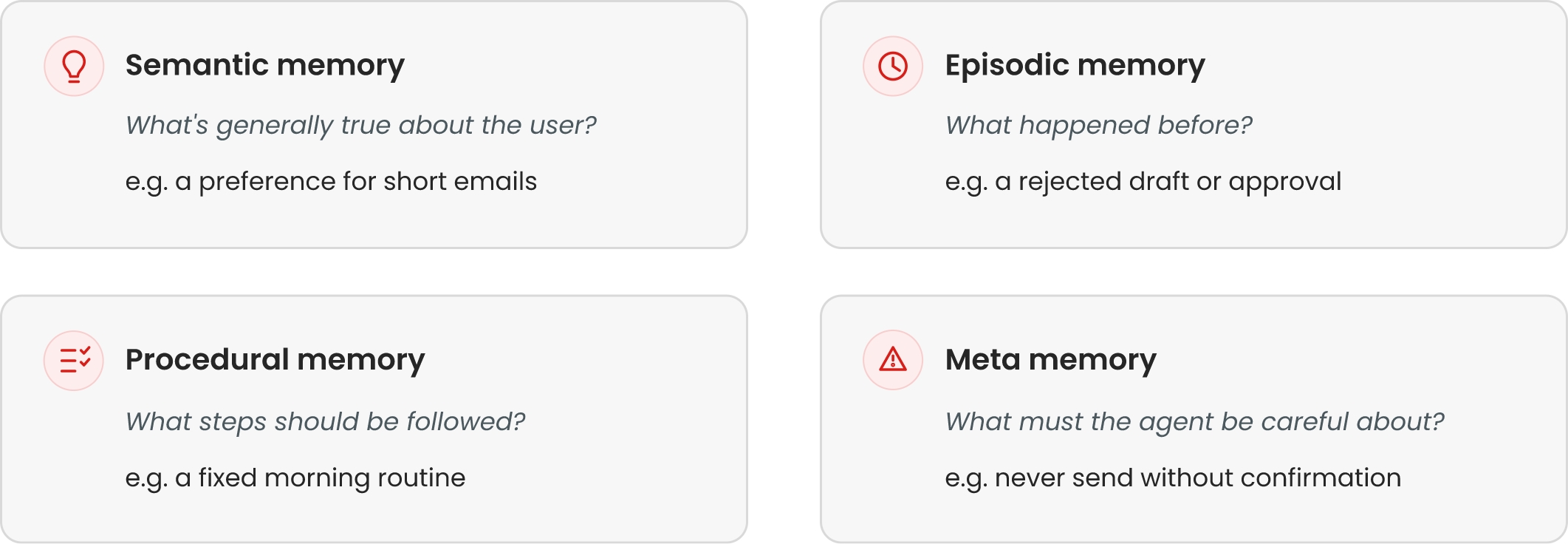
Treating all four as one undifferentiated memory pool is where many systems go wrong. A preference and a boundary don't carry the same weight, and mixing them up tends to produce assistants that are either too cautious about small things or not careful enough about the ones that matter.
### Why chat history isn't the same as memory
It's tempting to assume storing chat history gives an agent memory. It doesn't. History is a raw, repetitive record of everything said. Memory is the signal pulled out of it: structured, reusable, stripped of noise. The table below makes the difference concrete.
Raw chat history
Useful memory
“Keep it short.” “Less formal.” “More natural.” (three separate lines scattered across a transcript)
The user prefers short, natural, informal communication (one clear, reusable instruction)
“Option B seems best. Let's move forward.”
Option B was selected for the project
“First structure, then diagrams, then text.”
Preferred workflow: structure, then diagrams, then content
“Don't send this yet, let me review.”
Boundary: approval required before sending
Feeding raw history into every response creates noise. Extracting the right signal creates memory and determines whether [personalization](/blogs/when-ai-meets-the-drive-thru-lessons-from-starbucks-jack-in-the-box-and-beyond/) gets sharper with use or degrades as conversations pile up.
### The memory lifecycle
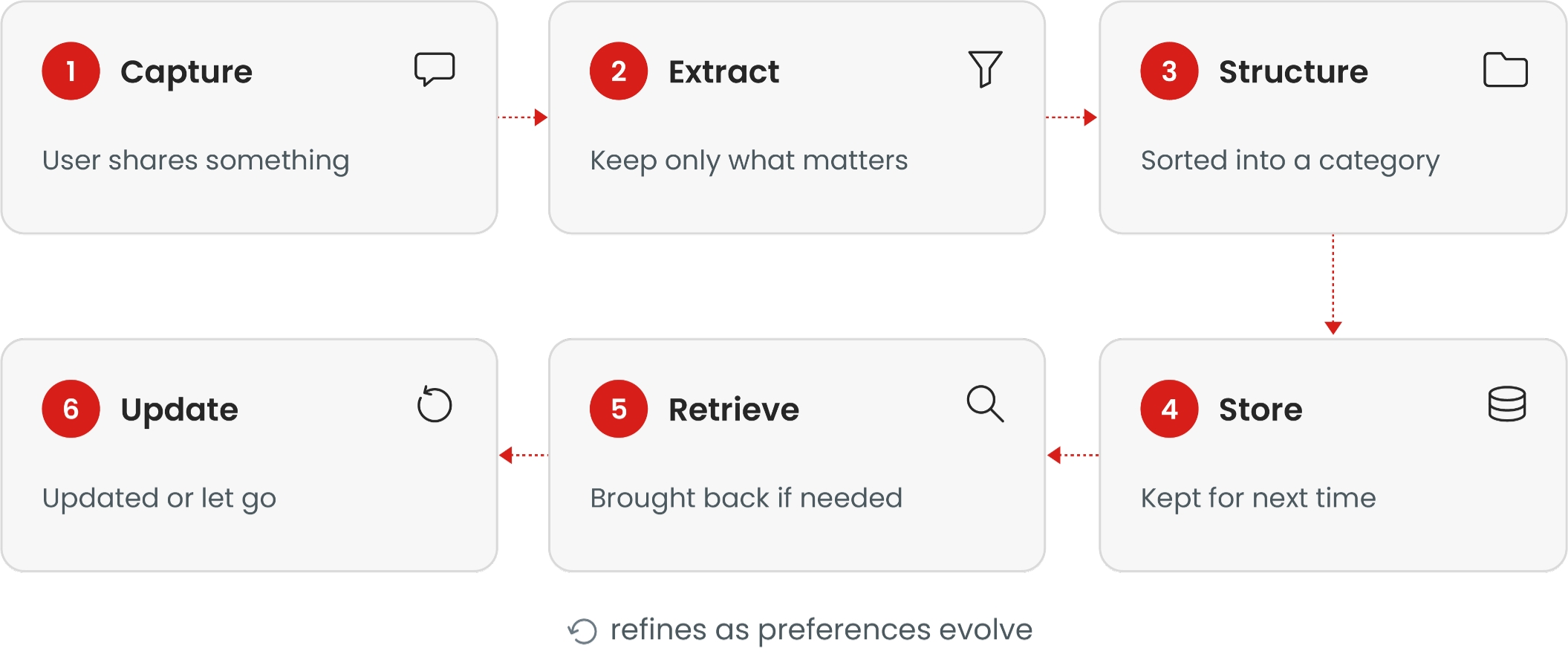
Memory isn't a database lookup performed once and forgotten. It's a lifecycle, and each stage does different work:
- Capture: The user expresses a signal through conversation or action.
- Extract: The system identifies what's reusable, stable, or important.
- Structure: The signal becomes a clean type, such as a preference, decision, workflow, or boundary.
- Store: The memory is saved outside the immediate prompt, so it survives across sessions.
- Retrieve and inject: The relevant memory is pulled into context only when it helps the current task.
- Update or forget: Outdated, duplicate, contradictory, or irrelevant memory is weakened or removed.
Preferences evolve too, and a good memory system has to keep up. “Keep it short” might later become “short by default, but detailed for technical topics,” and the system needs to refine that instruction over time rather than freeze the original one indefinitely.
## Memory design: what to keep, what to let go
Good memory design is as much about restraint as it is about capture. Remembering too much creates noise and can feel invasive. Remembering too little creates repeated friction that never goes away. Both carry real business risk, just in opposite directions, which is why deciding what belongs in memory matters as much as building the memory system itself.
[lc_get_post post_type="lc_block" slug="toggle-between-whats-worth-remembering"]
## Design principles for trustworthy memory
Building memory into an agent takes deliberate design, not just added storage. A few principles keep it dependable:
- Selective: Store what's likely to recur, not everything that's said. A repeated email style is worth keeping; a one-time mood isn't.
- Transparent: Users should be able to see, edit, or delete what's remembered about them, and the assistant should be able to explain why it did something a certain way.
- Context-aware: Temporary context shouldn't harden into a permanent trait. “I'm in a rush today” should shape today's answer, not become part of a lasting profile.
- Relevant: Retrieve only what serves the task at hand. Email tone helps with drafting a message; it has no business shaping a weekend plan.
- Adaptive: Update memory as preferences and goals evolve, rather than freezing an early instruction indefinitely.
- Privacy-first: Store sensitive information only with clear consent, and never surface it unprompted.
## Conclusion
Better models will keep raising the ceiling on what a single interaction can accomplish. But adoption hinges on whether an agent gets better the more it's used, or resets to zero every time, the real dividing line between a tool users tolerate and one they trust. Memory, designed with discipline, is what moves an agent across that line. Sigmoid works with enterprises building agentic AI systems to design the memory, context, and governance layers that make personalization reliable at scale, turning proof-of-concept agents into production-ready systems users can trust.
## References
1. A Survey on the Memory Mechanism of Large Language Model based Agents. [https://arxiv.org/abs/2404.13501](https://arxiv.org/abs/2404.13501)
2. Memory for Autonomous LLM Agents: Mechanisms, Evaluation, and Emerging Frontiers. [https://arxiv.org/abs/2603.07670](https://arxiv.org/abs/2603.07670)
3. Memory in the Age of AI Agents. [https://arxiv.org/abs/2512.13564](https://arxiv.org/abs/2512.13564)
4. Generative Agents: Interactive Simulacra of Human Behavior. [https://arxiv.org/abs/2304.03442](https://arxiv.org/abs/2304.03442)
5. Reflexion: Language Agents with Verbal Reinforcement Learning. [https://arxiv.org/abs/2303.11366](https://arxiv.org/abs/2303.11366)
6. MemGPT: Towards LLMs as Operating Systems. [https://arxiv.org/abs/2310.08560](https://arxiv.org/abs/2310.08560)
7. MemoryBank: Enhancing Large Language Models with Long-Term Memory. [https://arxiv.org/abs/2305.10250](https://arxiv.org/abs/2305.10250)
8. A-MEM: Agentic Memory for LLM Agents. [https://arxiv.org/abs/2502.12110](https://arxiv.org/abs/2502.12110)
9. How Memory Management Impacts LLM Agents: An Empirical Study of Experience-Following Behavior. [https://arxiv.org/abs/2505.16067](https://arxiv.org/abs/2505.16067)
10. Reflective Memory Management for Long-term Dialogue Agents. [https://aclanthology.org/2025.acl-long.413/](https://aclanthology.org/2025.acl-long.413/)
## About the Author
**Avijit Swain** is a Lead Data Scientist at Sigmoid. He specializes in GenAI and Agentic AI. He has built multiple agentic solutions spanning sales insights, talent acquisition, and AI-powered assistants, helping enterprises turn emerging AI capabilities into practical, production-ready solutions.
**Yashasva Bafna** is a Data Scientist at Sigmoid, with a background in electronics from NIT Tiruchirappalli. With his growing expertise in applied data science and AI, he helps build solutions that turn complex data into practical, real-world impact.
[lc_the_tags]
## Suggested readings
[View all](/blogs/)

#### Building trustworthy Agentic AI starts with the right guardrails
[Read blog](/blogs/building-trustworthy-agentic-ai-starts-with-the-right-guardrails/)

#### Agentic AI mesh: The new architecture for intelligent business
[Read blog](/blogs/agentic-ai-mesh-the-new-architecture-for-intelligent-business/)

#### The GenAI adoption triad: Responsibility, Ethics, and Explainability
[Read blog](/blogs/the-genai-adoption-triad-responsibility-ethics-and-explainability/)
## Featured blogs
[lc_get_posts post_type="post"
posts_per_page="4" orderby="date" output_view="lc_get_posts_mycustom_view" output_number_of_columns="4"
output_wrapper_class="row" output_article_class="shadow" output_hide_elements="Excerpt"
output_excerpt_length="0" output_excerpt_text="Read More" output_heading_tag="span"
output_featured_image_format="thumbnail" output_featured_image_class="card-img-left" ]
## Share
[addtoany]
## Subscribe to get latest insights
## Talk to our experts
Get the best ROI with Sigmoid’s services in data engineering and AI
---
## Categories
- AI/ML
---
## Navigation
- [Company](/about-sigmoid)
- [Newsroom](/newsroom)
- [Life at Sigmoid](/careers)
- [Takshashila](/takshashila)
- [Contact Us](/contact-us)
- [AI Strategy Blueprint your AI advantage](/enterprise-ai-strategy/)
- [Generative AI Drive innovation with Generative AI](/generative-ai/)
- [Responsible AI Build trust with ethical AI practices](/responsible-ai-in-enterprise/)
- [Agentic AI Reshape business with scalable agentic systems](/agentic-ai-solutions/)
- [AI Managed Services Ensure reliable AI performance](/ai-managed-services/)
- [Advanced Analytics Transform your business with data-driven insights](/advanced-data-analytics-solutions/)
- [Download Whitepaper](/ebooks-whitepapers/the-new-qsr-playbook-transforming-menu-strategy-into-a-growth-engine/)
- [Data Strategy Strong data foundations for scalable AI](/data-analytics-strategy/)
- [Data Management Leverage data as a strategic asset](/ai-data-management-services/)
- [Data Ops Automate data for speed and quality](/data-devops/)
- [Data Engineering Deliver insights faster with scalable pipelines](/data-engineering/)
- [Cloud Transformation Modernize data to maximise efficiency](/cloud-migration/)
- [Download Whitepaper](/ebooks-whitepapers/building-data-products-in-a-data-mesh-to-drive-business-value/)
- [Data Modeling Structure data for better decisions](/data-modeling-services/)
- [Data Visualization Transform data into actionable stories](/data-visualization-service/)
- [BI Migration Enhance decision making with modern BI tools](/bi-migration/)
- [Data Observability Build trust with healthy, accurate data](/data-observability/)
- [Automated Insights Make smarter decisions with auto-generated insights](/automated-insights/)
- [Download Whitepaper](/ebooks-whitepapers/how-cognitive-bi-drives-an-intelligent-enterprise/)
- [CPG & Retail End-to-end analytics for planning, operations, and commercial excellence](/industries/cpg-analytics/)
- [Life Sciences Trusted intelligence across clinical, commercial, and operational workflows](/industries/life-sciences/)
- [Financial Services AI-powered analytics for risk, compliance and customer experience](/industries/banking-financial-analytics-services/)
- [Download Infographic](/wp-content/uploads/2026/03/Infographic_Maturity-Framework-for-Scaling-Agentic-AI.pdf)
- [MediaIQ Advanced platform for in-flight marketing measurement](/accelerators/sigmoid-mediaiq-multi-touch-attribution-tool/)
- [CampaignIQ AI-driven platform for optimized campaign budget allocation](/accelerators/sigmoid-campaigniq/)
- [AssistBot GenAI email assistant that automates human-like responses](/accelerators/sigmoid-assistbot-for-ai-email-assistant/)
- [CreativeBot GenAI tool for personalized and brand-aligned creative design](/accelerators/sigmoid-creativebot/)
- [SocialBot GenAI platform to analyze digital conversations and trends](/accelerators/#marketing|socialbot)
- [DemandIQ Predict trends accurately and optimize inventory management](/accelerators/sigmoid-demandiq/)
- [NetworkIQ Track and optimize logistics operations in real-time to quickly address disruptions](/accelerators/sigmoid-networkiq/)
- [SupplyIQ End-to-end platform to optimize supply chain operations](/accelerators/sigmoid-supplyiq/)
- [ProcurementIQ Automated procurement operations for maximum savings, compliance and efficiency](/accelerators/sigmoid-procurementiq/)
- [RapidML Accelerated deployment for machine learning models](/accelerators/sigmoid-rapidml/)
- [DataGuard Comprehensive platform for proactive data quality management](/accelerators/data-quality-tool-sigmoid-dataguard/)
- [CloudPulse Cloud cost optimization platform with multi-cloud management](/accelerators/sigmoid-cloudpulse/)
- [RAPID GenAI foundation with built-in governance and cost clarity](/accelerators/sigmoid-rapid/)
- [AnalyticsBot GenAI based platform to streamline decision-making in analytics](/accelerators/sigmoid-analyticsbot/)
- [DataConnect Seamlessly ingest, integrate and harmonize data from diverse sources](/accelerators/sigmoid-dataconnect/)
- [Reconica AI-powered data harmonization and reconciliation engine](/accelerators/sigmoid-reconica/)
- [ConverseBot GenAI driven insights generation for automated insights from reports](/accelerators/#sales|conversebot)
- [iNRM Cross-lever revenue growth optimization platform](/accelerators/sigmoid-inrm/)
- [AssortmentIQ Optimize shelf layouts and assortment mix at scale with AI-based insights](/accelerators/sigmoid-assortmentiq/)
- [Read Whitepaper](/ebooks-whitepapers/building-agentic-ai-chatbots-for-business-process-transformation/)
- [Listen Podcast](/events/podcast/how-jack-in-the-box-is-redefining-personalization-and-supply-chain-with-ai/)
- [Blogs](/blogs/)
- [White Papers](/ebooks-whitepapers/)
- [Case Studies](/case-studies/)
- [Podcast](/events/podcast/#Podcasts)
- [Download Case Study](/case-studies/ai-based-dynamic-targeting-and-personalized-hcp-engagement-for-pharma-marketing/)
- [ConverseBot](/accelerators/#sales|conversebot/)
## Tags
- Agentic AI
- AI Agents
- GenAI
- LLMOps
- Personalization
---
## Footer Links
- [Talk to our AI experts](/contact-us/)
- [AI Strategy](/enterprise-ai-strategy/)
- [Agentic AI](/agentic-ai-solutions/)
- [Generative AI](/generative-ai/)
- [AI Managed Services](/ai-managed-services/)
- [Responsible AI](/responsible-ai-in-enterprise/)
- [Advanced Analytics](/advanced-data-analytics-solutions/)
- [Data Strategy](/data-analytics-strategy//)
- [Data Engineering](/data-engineering/)
- [Data Management](/ai-data-management-services/)
- [Cloud Transformation](/cloud-transformation/)
- [Data Ops](/data-devops/)
- [Data Visualization](/data-visualization-service/)
- [Automated Insights](/automated-insights/)
- [BI Migration](/bi-migration/)
- [Data Modeling](/data-modeling-services/)
- [Data Observability](/data-observability/)
- [CPG & Retail](/industries/cpg-analytics/)
- [Financial Services](/industries/banking-financial-analytics-services/)
- [Life Sciences](/industries/life-sciences/)
- [Case Studies](/case-studies/)
- [Thought Leadership](/ebooks-whitepapers/)
- [Blogs](/blogs/)
- [Company](/about-sigmoid/)
- [Newsroom](/newsroom/)
- [Accelerators](/accelerators/)
- [Careers](/careers/)
- [Privacy Policy |](/privacy-policy/)
- [Cookie Policy](/cookie-policy/)