---
# Scaling Enterprise AI with LLMOps on Databricks
**URL:** https://www.sigmoid.com/blogs/scaling-enterprise-ai-with-llmops-on-databricks/
Date: 2026-06-10
Author: Joha Momin
Post Type: post
Summary: Enterprise investment in GenAI is accelerating, but scaling it remains elusive. Most organizations have already proven that AI can create value through...Read More...
Categories: AI/ML
Tags: Agentic AI, AI Governance, GenAI, LLMOps, MCP, Platform Engineering
Featured Image: https://www.sigmoid.com/wp-content/uploads/2026/06/Industrializing-GenAI-at-enterprise-scale-with-LLMOps-Banner.jpg
---
Enterprise investment in GenAI is accelerating, but scaling it remains elusive. Most organizations have already proven that AI can create value through copilots, agent-based applications, and domain-specific assistants. The challenge now is turning those isolated successes into enterprise capabilities that are secure, governed, and repeatable.
Yet for many organizations, the challenge now extends far beyond the model itself. The real challenge lies in managing how AI systems are deployed, integrated, evaluated, and governed across the enterprise. This is where LLMOps is becoming increasingly important; it provides the [framework for moving AI from experimentation to production](/ai-managed-services/). The next phase of enterprise AI will be defined not by model innovation alone, but by the ability to operationalize AI responsibly, reliably, and consistently across the business.
## Why GenAI initiatives stall after the pilot stage
Many organizations have demonstrated value through AI pilots and proof-of-concepts. Far fewer have established the operational foundations required to scale those successes across business functions, geographies, and use cases.
As adoption expands, AI teams often encounter a familiar set of challenges:
- Integrations that must be rebuilt for every new use case
- Manual evaluation processes that become difficult to scale
- Limited visibility into model performance and operational costs
- Increasing governance and compliance requirements
- Growing concerns around security, access controls, and data privacy
- Inconsistent deployment and monitoring practices across teams
These challenges rarely stem from the model itself. They emerge from the systems and processes surrounding it. Without a common operating model, organizations risk creating isolated AI solutions that are difficult to govern, maintain, and extend across the enterprise. As a result, the effort required to deploy each new application remains disproportionately high, slowing the pace of enterprise adoption.
Based on Sigmoid's experience helping Fortune 500 enterprises operationalize AI across consumer goods, healthcare, life sciences, and financial services, organizations that move beyond pilots share a common characteristic: they treat AI as a capability, not a collection of isolated use cases.
## A blueprint for building AI as a capability
Organizations that succeed typically progress through three stages of AI maturity, each building on the capabilities established in the previous phase.
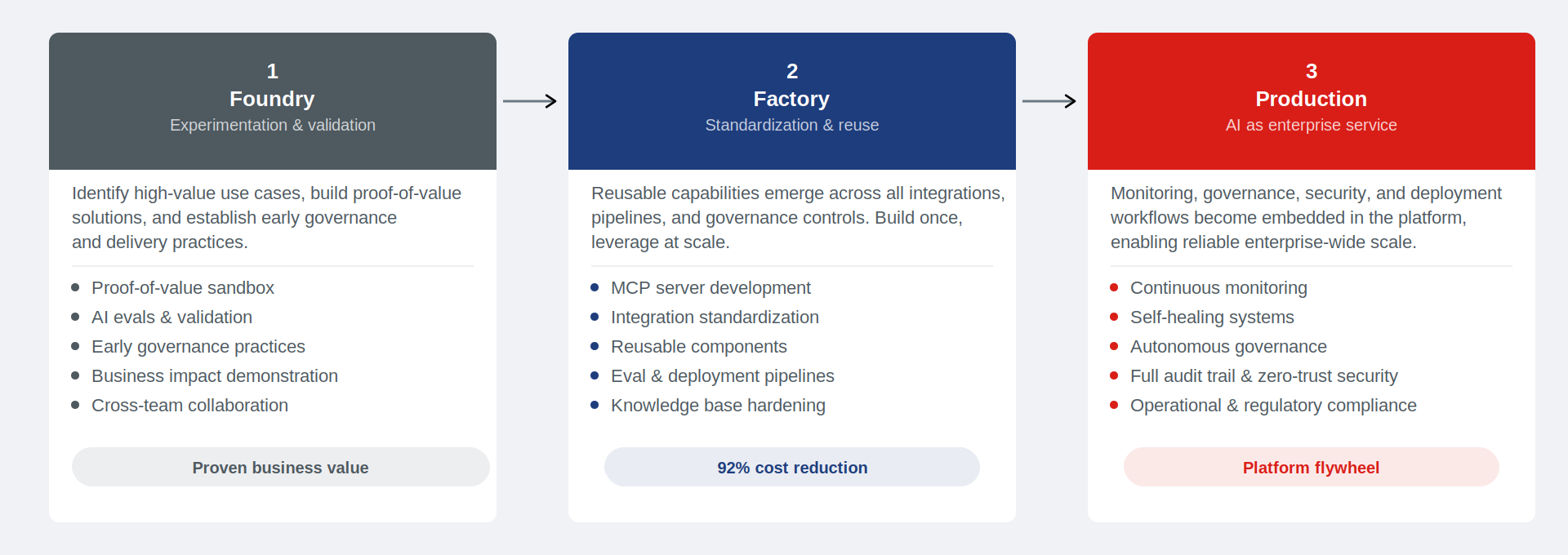
Fig.1. Stages of AI deployement
As organizations move from experimentation to production, reusable assets begin to generate cumulative value. Integration frameworks, governance controls, evaluation pipelines, and operational tooling can be reused across multiple AI initiatives, reducing deployment effort while improving consistency and control. As a result, the cost of building and deploying additional agents can decline by as much as 92%. Teams that once required months to launch new AI solutions can begin delivering production-ready agents in a matter of days.
### Operationalizing GenAI with RAPID and AgentBricks
Progressing from experimentation to enterprise-scale deployment requires more than reusable processes. Organizations also need a structured operating model that standardizes how AI systems are built, evaluated, governed, and deployed.
To help organizations accelerate this transition, Sigmoid developed the [RAPID framework](/accelerators/sigmoid-rapid/), a set of foundational principles designed to operationalize AI while maintaining governance, quality, and scalability.
Component
Purpose
Reusable foundations
Establish standardized assets, integrations, and workflows that can be leveraged across multiple AI initiatives.
Automated evaluation
Continuously measure quality, performance, and reliability throughout the AI lifecycle.
Platform governance
Embed security, compliance, lineage, and policy management into the platform from the outset.
Integrated delivery
Connect data, models, applications, and business workflows through standardized operating patterns.
Deployment at scale
Enable repeatable deployment and monitoring of AI systems across enterprise environments.
While RAPID provides the delivery model, organizations also need a unified technology foundation capable of supporting AI delivery at scale.
[Databricks](/databricks-partnership/) addresses this challenge by providing a unified environment for developing, evaluating, deploying, and governing AI agents through AgentBricks. By bringing together agent development, model management, evaluation, observability, and deployment workflows within a single ecosystem, AgentBricks helps organizations simplify the complexity traditionally associated with enterprise AI deployment.
AgentBricks provides a pre-integrated stack that aligns directly with Sigmoid's Foundry-to-Factory journey:
- Pre-built agent templates: Opinionated scaffolding for RAG agents, tool-calling agents, and multi-agent workflows, reducing Time-to-Factory from weeks to days.
- MLflow-native evaluation: Built-in integration with MLflow tracing and LLM evaluation, enabling automated quality scoring directly within the Databricks workspace.
- Continuous improvement loop: Feedback from production traces feeds back into evaluation datasets automatically, enabling iterative refinement without manual intervention.
- Unity Catalog governance: All agent artefacts, such as prompts, models, tools, chain configurations, are registered and governed through Unity Catalog with full lineage, versioning, and access controls.
Together, RAPID and AgentBricks provide a repeatable model for developing, governing, and scaling AI across the enterprise.
### Balancing flexibility with operational control
As AI adoption expands, organizations often face a difficult trade-off between architectural flexibility and operational consistency. While Sigmoid's RAPID framework is designed to operate across AWS, Azure, and GCP, many enterprises are increasingly standardizing their GenAI initiatives on Databricks because it provides a unified foundation for data, AI, governance, and operations.
By leveraging open standards, interoperable architectures, and multi-cloud deployment flexibility, organizations can scale AI initiatives without becoming tightly coupled to fragmented toolchains or proprietary ecosystems. This enables teams to maintain architectural choice while establishing a common operating model for enterprise AI.
Databricks supports this approach through a set of integrated capabilities that span the full AI lifecycle:
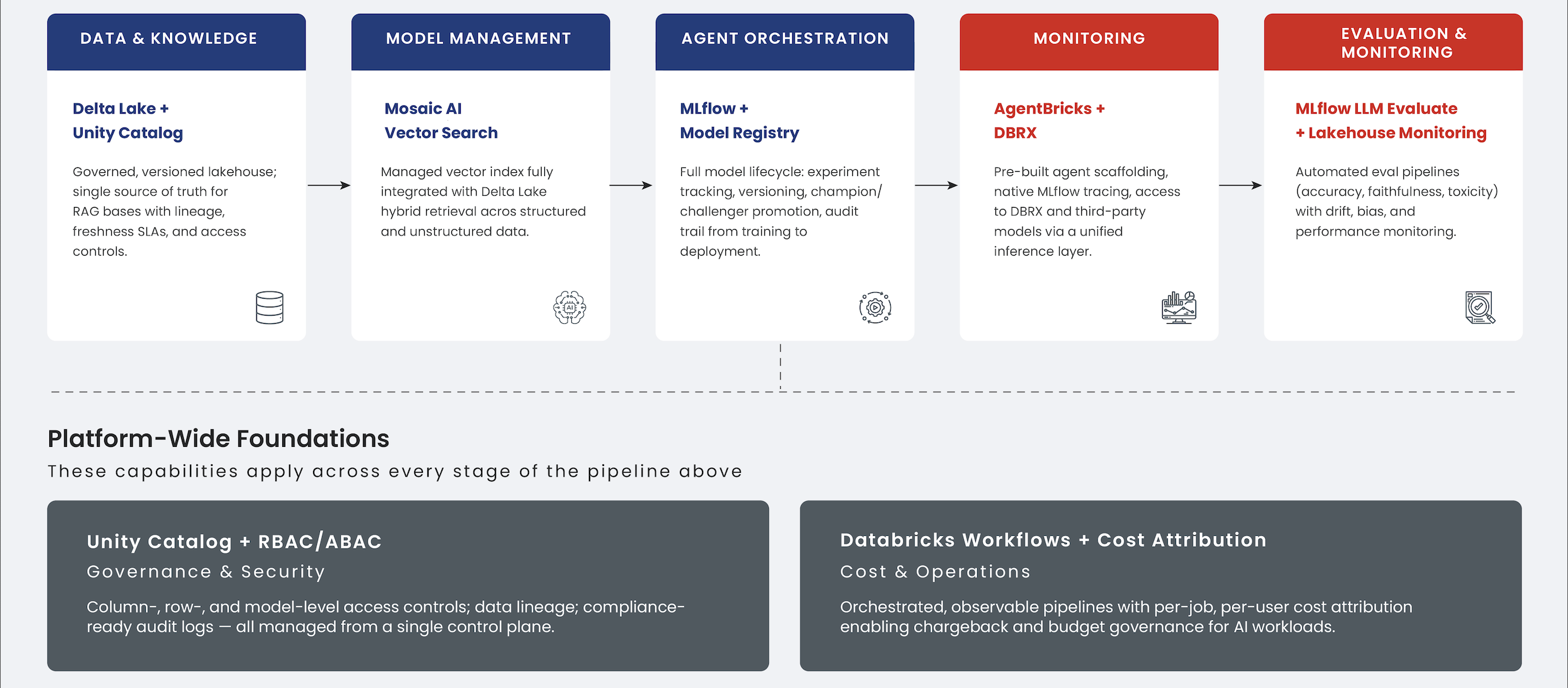
Fig.2. Core Databricks capabilities supporting enterprise-scale AI delivery
While these capabilities provide the foundation for building and deploying AI systems, a different challenge emerges as adoption scales: how do organisations consistently measure quality across hundreds of prompts, agents, and business workflows?
## Bringing automation to AI evaluation
Traditional software applications can be validated through deterministic testing. AI systems require a different approach. Outputs can vary with context, prompts, retrieved information, and model behaviour, making manual evaluation increasingly difficult to sustain as deployments grow. For many organizations, evaluation quickly becomes the bottleneck between experimentation and production.
To address this challenge, Sigmoid developed an automated evaluation framework designed to continuously assess the quality, reliability, and business relevance of AI-generated outputs across production environments.
Rather than relying on periodic human reviews, the framework applies a systematic evaluation process that measures AI performance across multiple dimensions, helping organizations identify quality issues early and build confidence in production systems.
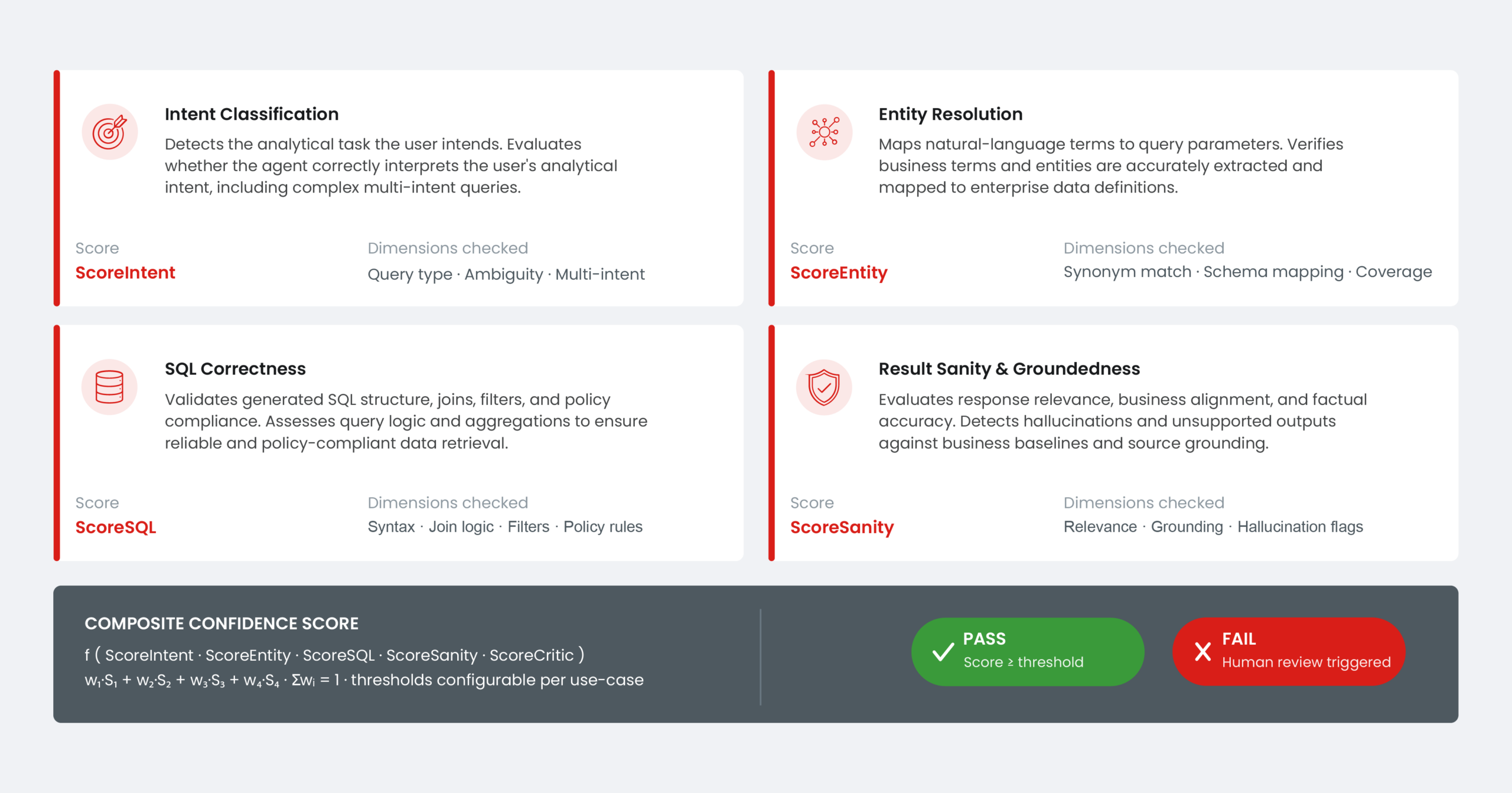
Fig.3. Enterprise AI evaluation framework
### Real-world deployment
A leading global consumer packaged goods company partnered with Sigmoid to operationalize AI across multiple business functions. As adoption expanded, the organization faced a growing challenge: manually validating AI outputs across hundreds of prompts and workflows was becoming increasingly resource-intensive and difficult to scale.
Sigmoid implemented the automated evaluation layer to enabled continuous assessment of AI-generated responses across production environments. The framework was deployed across 524 production prompts, evaluating outputs against predefined business and quality criteria while creating a repeatable approach to performance monitoring.
### Business Impact
The implementation delivered measurable improvements across both AI operations and governance:
- 90%+ accuracy in predicting response correctness across production prompts
- Significant reduction in manual evaluation effort
- Faster deployment and release cycles
- Improved visibility into AI quality and performance trends
- Greater confidence in scaling AI across business functions
More importantly, the organization established a repeatable evaluation framework that could be extended across future AI initiatives without rebuilding quality assurance processes from scratch.
As AI adoption accelerates, evaluation is becoming a core enterprise discipline rather than a post-deployment activity. Organizations that can continuously measure quality, trust, and business relevance will be better positioned to [scale AI responsibly](/responsible-ai-solutions/) while maintaining confidence in production outcomes. Evaluation establishes confidence in AI outputs. Governance ensures that confidence can be sustained at scale.
## Governance as an enabler of scaling GenAI
As AI systems become embedded in customer interactions, operational workflows, and decision-making processes, governance can no longer be treated as an afterthought. It must be engineered into the platform from the outset.
Many organizations approach governance as a compliance requirement. In practice, it is an enabler of scale. Without clear controls around data access, model behavior, security, and auditability, AI adoption often slows as risk concerns begin to outweigh business value.
This challenge becomes even more pronounced in highly regulated industries such as financial services, healthcare, life sciences, and consumer goods, where organizations must maintain visibility into how data is accessed, how decisions are generated, and how AI outputs are used.
Databricks provides several foundational capabilities that support enterprise AI governance, including Unity Catalog for centralized access control, lineage tracking, auditability, and policy enforcement. Combined with Sigmoid's governance frameworks, these capabilities help organizations establish trust across the AI lifecycle.
Key governance capabilities include:
- Role-based and attribute-based access controls
- End-to-end lineage across data, prompts, models, and outputs
- PII detection and data protection mechanisms
- Policy-driven access management
- Audit logging and compliance reporting
- Human-in-the-loop review workflows for high-risk use cases
As AI adoption expands, governance must mature alongside it. The objective is not to restrict innovation, but to create the controls necessary for innovation to scale responsibly.
## Standardizing enterprise AI integrations
As organizations move from deploying a handful of AI agents to managing dozens or even hundreds, integration complexity quickly becomes a bottleneck.
Many enterprise environments still rely on point-to-point integrations between applications, data sources, and business systems. While manageable for isolated deployments, this approach becomes increasingly difficult to maintain as AI adoption grows. Every new agent requires access to enterprise knowledge, operational systems, and business context. Without a standardized integration model, development teams often find themselves rebuilding the same connections repeatedly. This is where the Model Context Protocol (MCP) becomes increasingly important.
MCP provides a standardized way for AI agents to discover, access, and interact with enterprise systems through governed interfaces. Rather than creating custom integrations for each new use case, organizations can expose business capabilities through reusable services that can be leveraged across multiple agents.
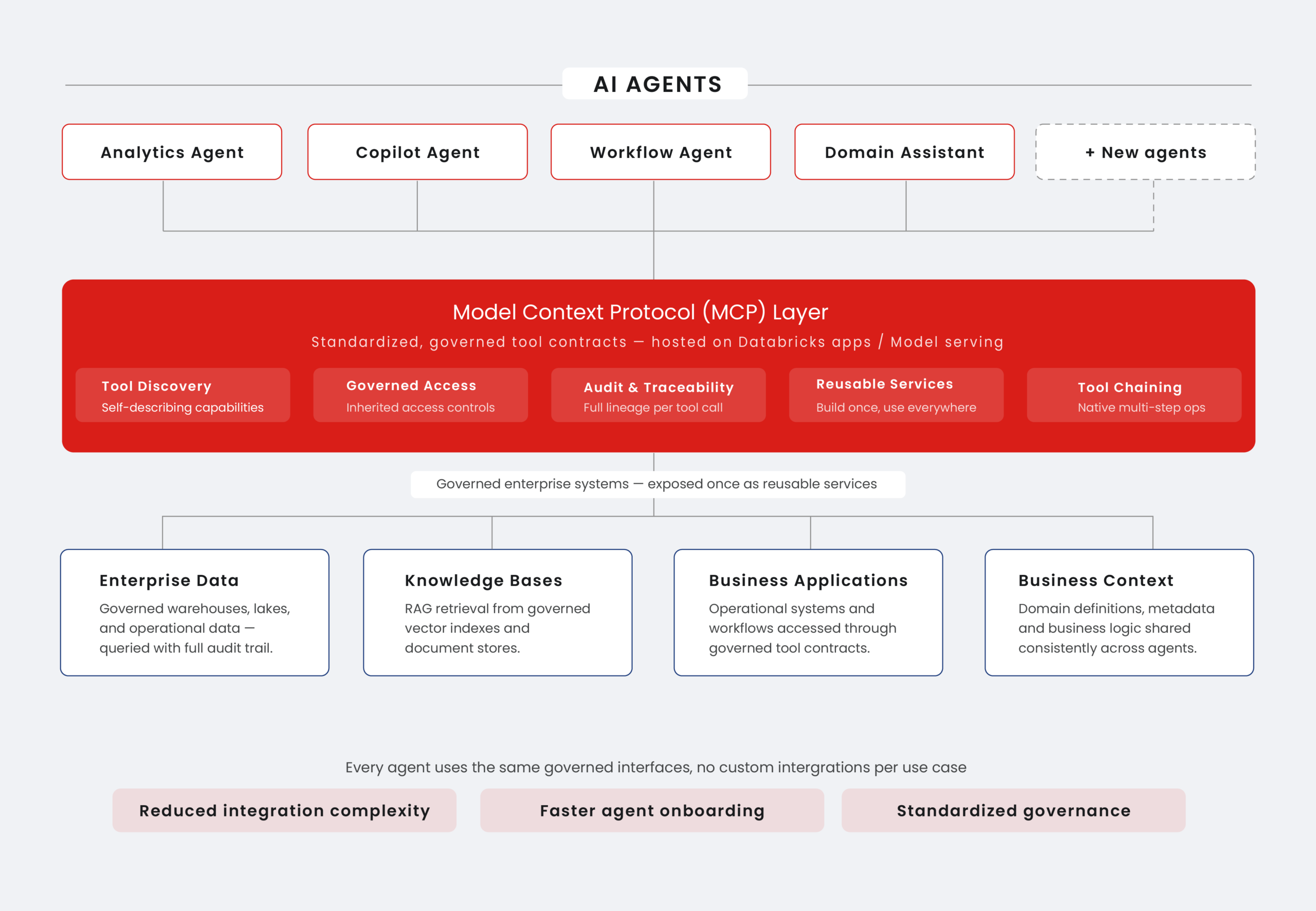
Fig.4. MCP-first architecture on Databricks
By adopting an [MCP-first approach](/blogs/agentic-ai-mesh-the-new-architecture-for-intelligent-business/), organizations can:
- Reduce integration complexity
- Accelerate onboarding of new AI agents
- Improve interoperability across systems
- Standardize governance and security controls
- Simplify long-term maintenance
Hosted within Databricks, MCP services can inherit the governance, monitoring, and access controls already established across the broader AI platform. As AI ecosystems continue to expand, integration standardization becomes increasingly important for maintaining agility without introducing operational complexity.
## From frameworks to business impact
Across industries, Sigmoid is helping organizations operationalize AI using repeatable frameworks, governed architectures, and scalable deployment models built on Databricks.
The examples below illustrate how enterprises are applying these capabilities to accelerate adoption while maintaining governance and operational control.
Organization
Use-case
Outcome
Global Consumer Packaged Goods Company
Automated evaluation framework for production AI systems
Achieved over 90% accuracy in predicting response correctness across 524 production prompts, significantly reducing manual evaluation effort
Leading Financial Services Institution
Enterprise-scale conversational analytics and AI enablement
Established a governed operating model for scaling AI while improving self-service access to business insights
Global Medical Device Manufacturer
AI-powered field force intelligence platform
Improved user productivity through automated insight generation and streamlined information access
OTC Healthcare Manufacturer
[Agentic cost-to-serve optimization](/case-studies/transforming-logistics-planning-with-agentic-ai-driven-optimization-and-scenario-simulation/)
Reduced logistics costs by 12% while cutting manual planning effort by approximately 50%
While the use cases vary, a common pattern emerges across deployments: organizations that achieve lasting AI adoption invest in the delivery, governance, and evaluation practices that support long-term success. The organizations realizing the greatest value from AI are those that treat these capabilities as strategic assets rather than implementation considerations. This mindset forms the foundation for building AI that lasts and consistently generates business value.
## Conclusion
The organizations that create lasting value from AI will not necessarily be those that experiment the fastest. They will be the ones that embed governance, evaluation, and operational discipline into every stage of the AI lifecycle. In the years ahead, competitive advantage will be shaped not only by access to AI but by the ability to operationalize it with consistency, accountability, and trust.
## About the author
**Nishant Ghosh** is Director, Partnerships at Sigmoid. He has extensive experience in technology consulting, strategic alliances and solution selling. Over the course of his career, he has worked with organizations across consumer goods, financial services, manufacturing, and other industries to accelerate their digital and analytics transformation initiatives. In his current role, Nishant leads Sigmoid's global cloud and independent software vendor (ISV) partnerships, driving strategic collaborations that help enterprises unlock greater value from data, AI, and modern technology platforms.
**Ritwick Pandey** is a Databricks Champion and a seasoned Data Engineering professional with over 14 years of experience in building scalable data platforms and driving data-driven solutions. He has extensive expertise across modern data engineering, cloud architectures, and AI-driven projects. With multiple certifications and badges in AWS and Databricks, along with experience across other cloud platforms, he brings a strong blend of technical depth and practical implementation skills.
[lc_the_tags]
## Suggested readings
[View all](/blogs/)

#### The GenAI adoption triad: Responsibility, Ethics, and Explainability
[Read blog](/blogs/the-genai-adoption-triad-responsibility-ethics-and-explainability/)

#### Building trustworthy Agentic AI starts with the right guardrails
[Read blog](/blogs/building-trustworthy-agentic-ai-starts-with-the-right-guardrails/)

#### How GenAI transforms customer experiences with personalized product recommendations
[Read blog](/blogs/how-genai-transforms-customer-experiences-with-personalized-product-recommendations/)
## Featured blogs
[lc_get_posts post_type="post"
posts_per_page="4" orderby="date" output_view="lc_get_posts_mycustom_view" output_number_of_columns="4"
output_wrapper_class="row" output_article_class="shadow" output_hide_elements="Excerpt"
output_excerpt_length="0" output_excerpt_text="Read More" output_heading_tag="span"
output_featured_image_format="thumbnail" output_featured_image_class="card-img-left" ]
## Share
[addtoany]
## Subscribe to get latest insights
## Talk to our experts
Get the best ROI with Sigmoid’s services in data engineering and AI
---
## Categories
- AI/ML
---
## Navigation
- [Company](/about-sigmoid)
- [Newsroom](/newsroom)
- [Life at Sigmoid](/careers)
- [Takshashila](/takshashila)
- [Contact Us](/contact-us)
- [AI Strategy Blueprint your AI advantage](/enterprise-ai-strategy/)
- [Generative AI Drive innovation with Generative AI](/generative-ai/)
- [Responsible AI Build trust with ethical AI practices](/responsible-ai-in-enterprise/)
- [Agentic AI Reshape business with scalable agentic systems](/agentic-ai-solutions/)
- [AI Managed Services Ensure reliable AI performance](/ai-managed-services/)
- [Advanced Analytics Transform your business with data-driven insights](/advanced-data-analytics-solutions/)
- [Download whitepaper](/ebooks-whitepapers/the-new-qsr-playbook-transforming-menu-strategy-into-a-growth-engine/)
- [Data Strategy Strong data foundations for scalable AI](/data-analytics-strategy/)
- [Data Management Leverage data as a strategic asset](/ai-data-management-services/)
- [DataOps Automate data for speed and quality](/data-devops/)
- [Forward Deployed Engineering Scale enterprise AI with FDEs & specialized agents](/forward-deployed-engineering/)
- [Data Engineering Deliver insights faster with scalable pipelines](/data-engineering/)
- [Cloud Transformation Modernize data to maximise efficiency](/cloud-migration/)
- [Download whitepaper](/ebooks-whitepapers/building-data-products-in-a-data-mesh-to-drive-business-value/)
- [Data Modeling Structure data for better decisions](/data-modeling-services/)
- [Data Visualization Transform data into actionable stories](/data-visualization-service/)
- [BI Migration Enhance decision making with modern BI tools](/bi-migration/)
- [Data Observability Build trust with healthy, accurate data](/data-observability/)
- [Automated Insights Make smarter decisions with auto-generated insights](/automated-insights/)
- [Download whitepaper](/ebooks-whitepapers/how-cognitive-bi-drives-an-intelligent-enterprise/)
- [CPG & Retail End-to-end analytics for planning, operations, and commercial excellence](/industries/cpg-analytics/)
- [Life Sciences Trusted intelligence across clinical, commercial, and operational workflows](/industries/life-sciences/)
- [Banking & Financial Services AI-powered analytics for risk, compliance and customer experience](/industries/banking-financial-analytics-services/)
- [Insurance Modernize core insurance platforms and unlock new revenue streams with AI](/industries/insurance-reimagined-with-ai/)
- [Download infographic](/wp-content/uploads/2026/03/Infographic_Maturity-Framework-for-Scaling-Agentic-AI.pdf)
- [Helios Turn marketing data into measurable business outcomes](/marketing-suite-helios/)
- [Stratos AI-powered platform for resilient supply chains](/supply-chain-stratos/)
- [DataGuard Agentic AI platform for data quality and governance](/data-quality-dataguard/)
- [MediaIQ Advanced platform for in-flight marketing measurement](/accelerators/sigmoid-mediaiq-multi-touch-attribution-tool/)
- [CampaignIQ AI-driven platform for optimized campaign budget allocation](/accelerators/sigmoid-campaigniq/)
- [AssistBot GenAI email assistant that automates human-like responses](/accelerators/sigmoid-assistbot-for-ai-email-assistant/)
- [CreativeBot GenAI tool for personalized and brand-aligned creative design](/accelerators/sigmoid-creativebot/)
- [SocialBot GenAI platform to analyze digital conversations and trends](/accelerators/#marketing|socialbot)
- [DemandIQ Predict trends accurately and optimize inventory management](/accelerators/sigmoid-demandiq/)
- [NetworkIQ Track and optimize logistics operations in real-time to quickly address disruptions](/accelerators/sigmoid-networkiq/)
- [SupplyIQ End-to-end platform to optimize supply chain operations](/accelerators/sigmoid-supplyiq/)
- [ProcurementIQ Automated procurement operations for maximum savings, compliance and efficiency](/accelerators/sigmoid-procurementiq/)
- [RapidML Accelerated deployment for machine learning models](/accelerators/sigmoid-rapidml/)
- [DataGuard Comprehensive platform for proactive data quality management](/accelerators/data-quality-tool-sigmoid-dataguard/)
- [CloudPulse Cloud cost optimization platform with multi-cloud management](/accelerators/sigmoid-cloudpulse/)
- [RAPID GenAI foundation with built-in governance and cost clarity](/accelerators/sigmoid-rapid/)
- [AnalyticsBot Conversational analytics for faster business decisions](/accelerators/sigmoid-analyticsbot/)
- [DataConnect Seamlessly ingest, integrate and harmonize data from diverse sources](/accelerators/sigmoid-dataconnect/)
- [Reconica AI-powered data harmonization and reconciliation engine](/accelerators/sigmoid-reconica/)
- [ConverseBot GenAI driven insights generation for automated insights from reports](/accelerators/#sales|conversebot)
- [iNRM Cross-lever revenue growth optimization platform](/accelerators/sigmoid-inrm/)
- [AssortmentIQ Optimize shelf layouts and assortment mix at scale with AI-based insights](/accelerators/sigmoid-assortmentiq/)
- [Read whitepaper](/ebooks-whitepapers/building-agentic-ai-chatbots-for-business-process-transformation/)
- [Listen Podcast](/events/podcast/how-jack-in-the-box-is-redefining-personalization-and-supply-chain-with-ai/)
- [Blogs](/blogs/)
- [White Papers](/ebooks-whitepapers/)
- [Case Studies](/case-studies/)
- [Podcast](/events/podcast/#Podcasts)
- [Download case study](/case-studies/ai-based-dynamic-targeting-and-personalized-hcp-engagement-for-pharma-marketing/)
- [ConverseBot](/accelerators/#sales|conversebot/)
## Tags
- Agentic AI
- AI Governance
- GenAI
- LLMOps
- MCP
- Platform Engineering
---
## Footer Links
- [Talk to our AI experts](/contact-us/)
- [AI Strategy](/enterprise-ai-strategy/)
- [Agentic AI](/agentic-ai-solutions/)
- [Generative AI](/generative-ai/)
- [AI Managed Services](/ai-managed-services/)
- [Responsible AI](/responsible-ai-in-enterprise/)
- [Advanced Analytics](/advanced-data-analytics-solutions/)
- [Data Strategy](/data-analytics-strategy//)
- [Data Engineering](/data-engineering/)
- [Data Management](/ai-data-management-services/)
- [Cloud Transformation](/cloud-transformation/)
- [DataOps](/data-devops/)
- [Forward Deployed Engineering](/forward-deployed-engineering/)
- [Data Visualization](/data-visualization-service/)
- [Automated Insights](/automated-insights/)
- [BI Migration](/bi-migration/)
- [Data Modeling](/data-modeling-services/)
- [Data Observability](/data-observability/)
- [CPG & Retail](/industries/cpg-analytics/)
- [Life Sciences](/industries/life-sciences/)
- [Banking & Financial Services](/industries/banking-financial-analytics-services/)
- [Insurance](/industries/insurance-reimagined-with-ai/)
- [Case Studies](/case-studies/)
- [Thought Leadership](/ebooks-whitepapers/)
- [Blogs](/blogs/)
- [Helios](/marketing-suite-helios/)
- [Stratos](/supply-chain-stratos/)
- [DataGuard](/data-quality-dataguard/)
- [Company](/about-sigmoid/)
- [Newsroom](/newsroom/)
- [Accelerators](/accelerators/)
- [Careers](/careers/)
- [Privacy Policy |](/privacy-policy/)
- [Cookie Policy](/cookie-policy/)