---
# Maximizing on-shelf availability for CPGs with Machine Learning
**URL:** https://www.sigmoid.com/ebooks-whitepapers/maximizing-on-shelf-availability-for-cpgs-with-machine-learning/
Date: 2023-03-16
Author: Sigmoid
Post Type: page
Summary: Maximizing on-shelf availability for CPGs with Machine Learning Chapter- 1 Introduction Chapter- 2 Problem areas studied Chapter- 3 Solution approach Chapter- 4...Read More...
Featured Image: https://www.sigmoid.com/wp-content/uploads/2023/04/CPGs-machine-learning.jpg
---
# Maximizing on-shelf availability for CPGs with Machine Learning
[fluentform id="146"]
[Chapter- 1 Introduction](#chapter-1)
[Chapter- 2 Problem areas studied](#chapter-2)
[Chapter- 3 Solution approach](#chapter-3)
[Chapter- 4 Solution implementation and success story](#chapter-4)
## 1. Introduction
As the [CPG industry](/industries/cpg-analytics/) moves towards adopting & applying AI and ML solutions to more complicated
use cases, there are a few low hanging fruits which have not been tackled by the wider industry yet -
manufacturers and retailers alike!
Despite the COVID-19 pandemic, the consumer packaged goods industry reported record sales in 2020
and sustained growth in 2021. However, in the US, 7.4% of sales were not realized due to out-of-stock/
out-of-shelf items, costing retailers $82 billion in 2021 alone [**[Nielsen IQ 2022]**](https://nielseniq.com/global/en/news-center/2022/nielseniq-launches-on-shelf-availability-osa-barometer-for-u-s-retailers/).
On-shelf availability (OSA) and consequently the accuracy of reported inventory is one such challenge
which is increasingly becoming a primary focus area for a number of manufacturers in the recent period,
where the focus is on identifying inventory compliance gaps in the retailer network, and driving retailer’s
adherence to ensure sell-out maximization.
While retail technology has been steadily improved over the last decades, many operational factors still
contribute to generate inventory record inaccuracies including:
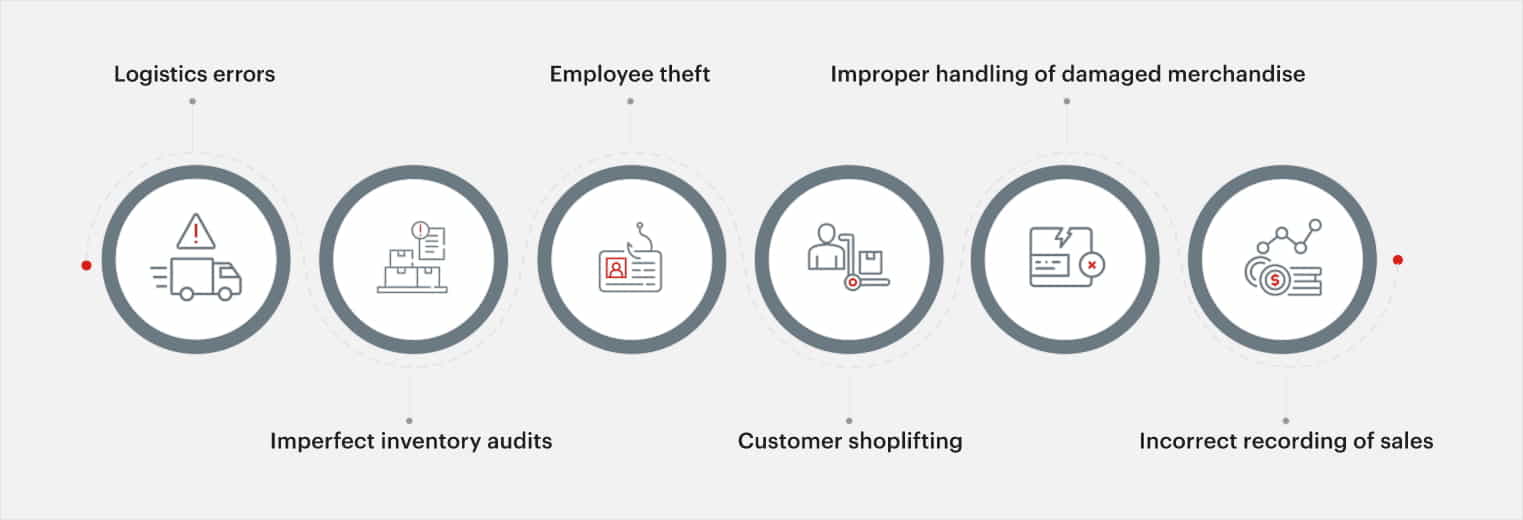
Market studies indicate that the average inventory accuracy amongst retailers is staggeringly low,
ranging between 60 to 65% [**[MarketScale]**](https://marketscale.com/industries/retail/what-impact-does-inventory-accuracy-have-on-retail-sales-and-loss/).
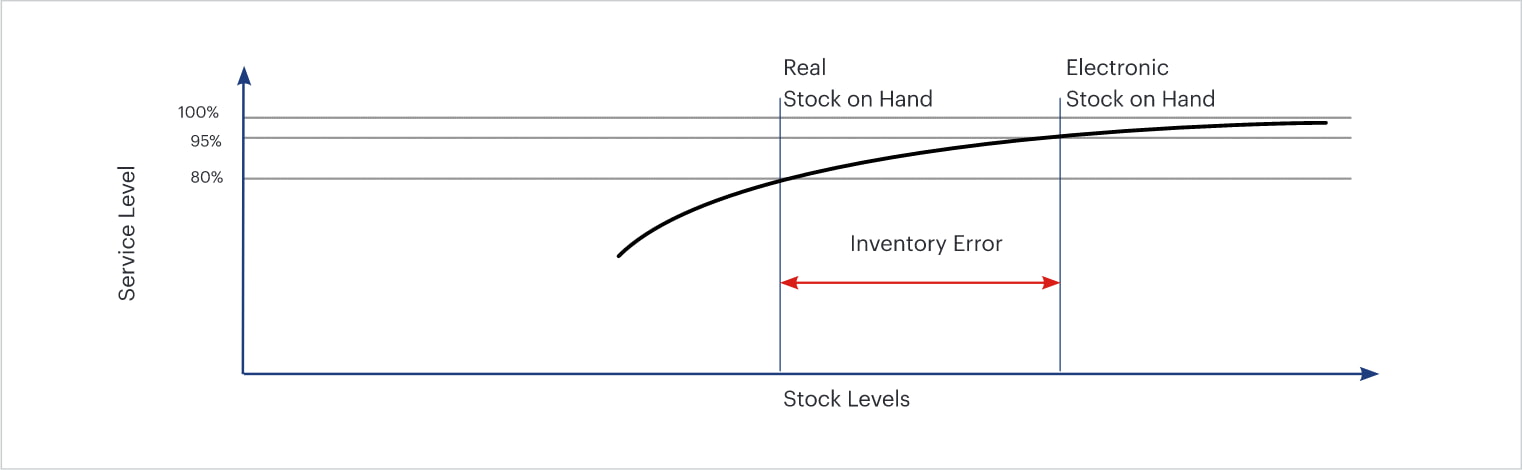
Figure 1 illustrates how a wrong inventory record will not only block a replenishment trigger required
to backfill the quantities, it will also be leading to low service level, i.e. greater number of zero sell-out
scenarios.
While the On-ground sales team’s sample audits can provide an indicative (sampled) view into a retailer’s
inventory practices, we propose looking at the issue supported by [Advanced Analytics](/data-science-services/) approaches.
In the next section, we will discuss two specific inventory inaccuracy scenarios and their typical data
behavior
## 2. Problem areas studied
**In this whitepaper, we discuss two problem areas impacting the quality of On-shelf availability**

## Phantom Inventory

## Put-away compliance
(I) Phantom Inventory - Mismatch in digital vs. physical inventory
This scenario reveals instances of incorrect inventory reporting, wherein the gap between physical and
digital inventory files has been creeped in due to some of the reasons mentioned in the previous section.
In our analysis, we will be focussing on the phantom inventory scenarios where reported inventory is
higher than physical inventory, particularly the negative effects of this on sell-out. This gap is termed
here as “phantom inventory”.
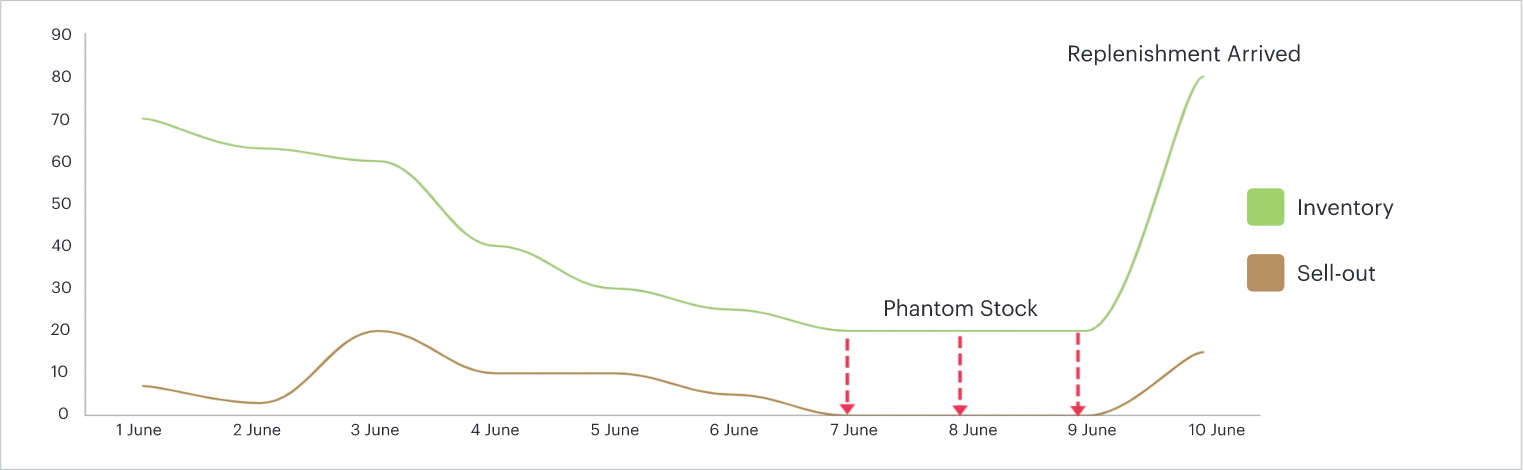
Looking at the behavior of Inventory and Sell-out lines in Figure 2 - when the reported inventory level
stays at a level >20, we see non-zero sell-out events taking place for 3 days consecutively, indicating that
the retailer has “likely” run out of physical stock and has no physical units to present to the prospective
customer. These zero sell-out events continue till the store has received more inventory through
replenishment, post which sales start picking up again.
(II) Put-away compliance - Delay in shelving the received items
Inventory sent to the store for a special promotion is often marooned in the backroom because store
managers didn’t run the promotion or stocked the products in a haphazard way. Per industry best
practices, a manufacturer expects a retailer to stock their shelves with the received inventory overnight
or within a 24 hours period.
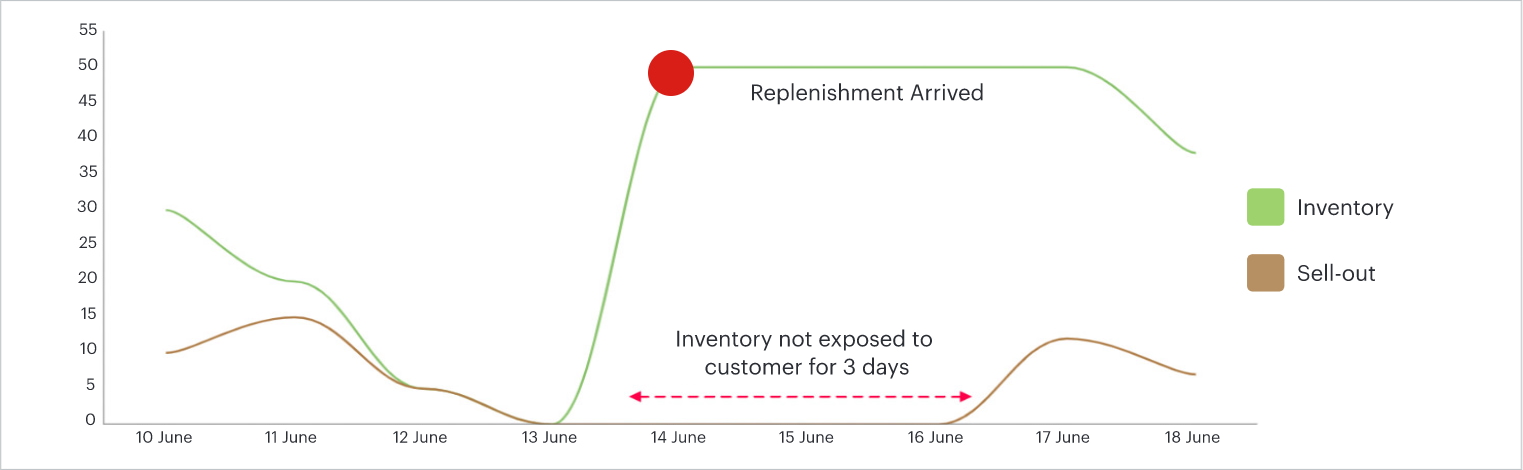
However, looking at the behavior of Inventory and Sell-out lines in Figure 3, we see that as soon as inventory is credited into the store’s digital file, we see zero sell-out events occurring for 3 days consecutively
before sales picking up again, “likely” indicating that although retailer has received the scanned inbound
stock, the stock is dwelling in the store back-office for 3 days before being put on the shelves.
Notice the word “likely” in both observations above, we call these as likely scenarios because there are
always probabilities of false positives, i.e. there could be natural zero sell-out events happening at a
given inventory level, and our data points necessarily are not all indicating an inventory compliance issue
at retailers location. Example, we may be seeing zero sell-out events at a certain inventory level because
there is no customer demand, which in turn could be due to,

low footfall

high prices

competitors’ products under heavy promotion

retailer intentionally holding back stock in back-office if the stock is supposed to be exposed only starting a given date
Hence, to understand confidence in the Phantom and Put-away non-compliance events, we will
substantiate the analysis with demand probabilistic components (taking into account above listed
factors) and categorize events into High/Medium/Low confidence buckets.
## 3. Solution approach
A total 2 years of Daily inventory, sell-out and sell-in data was ingested, harmonized and prepared for
the analysis. 1st stage of analysis involves identifying the phantom & PCA instances across timeline by
isolating
Incidences of continuous zero sales (for minimum 2 days) in the store coupled with an inventory
minima (phantom)
Incidences of zero sales (for minimum 2 days) in the store coupled with a post replenishment scenario
(PCA)
A simplistic illustration of the output format focussing on phantom inventory incidence identification
and confidence assignment is given below.
Date
SKU ID
Store ID
Phantom Flag
PAC Flag
Phantom Conf_1
Phantom Conf_2
Phantom Conf_3
Overall Confidence Score (Phantom)
1 Jul ‘22
Prod1
Sto_1
1
0
0.8
0.9
0.7
H
1 Jul ‘22
Prod2
Sto_2
0
1
0.6
0.7
0.6
M
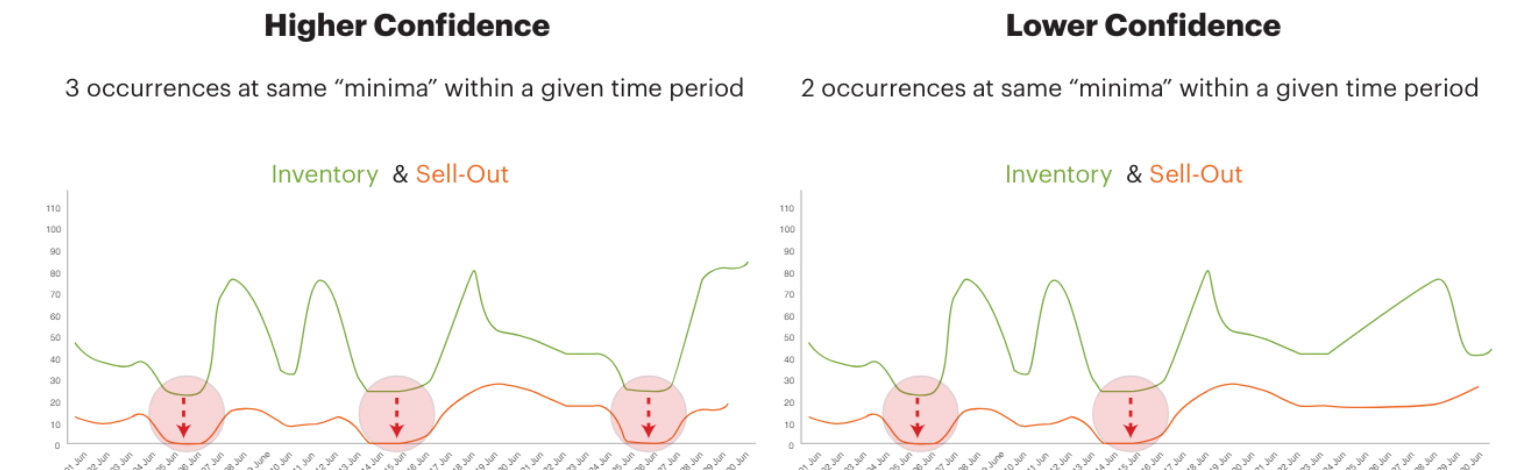
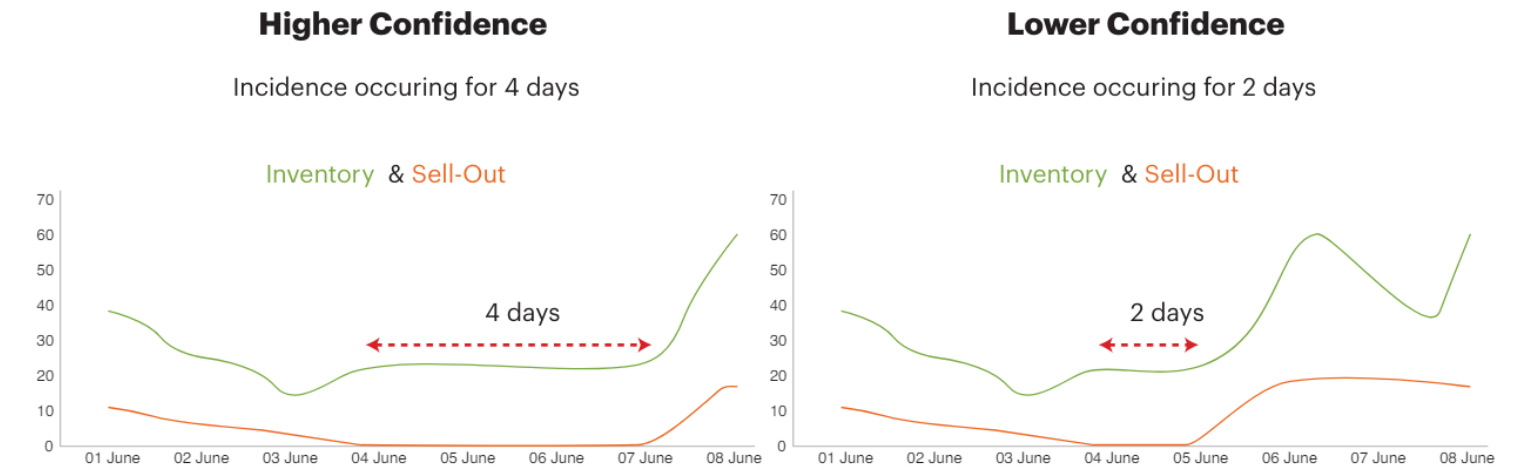
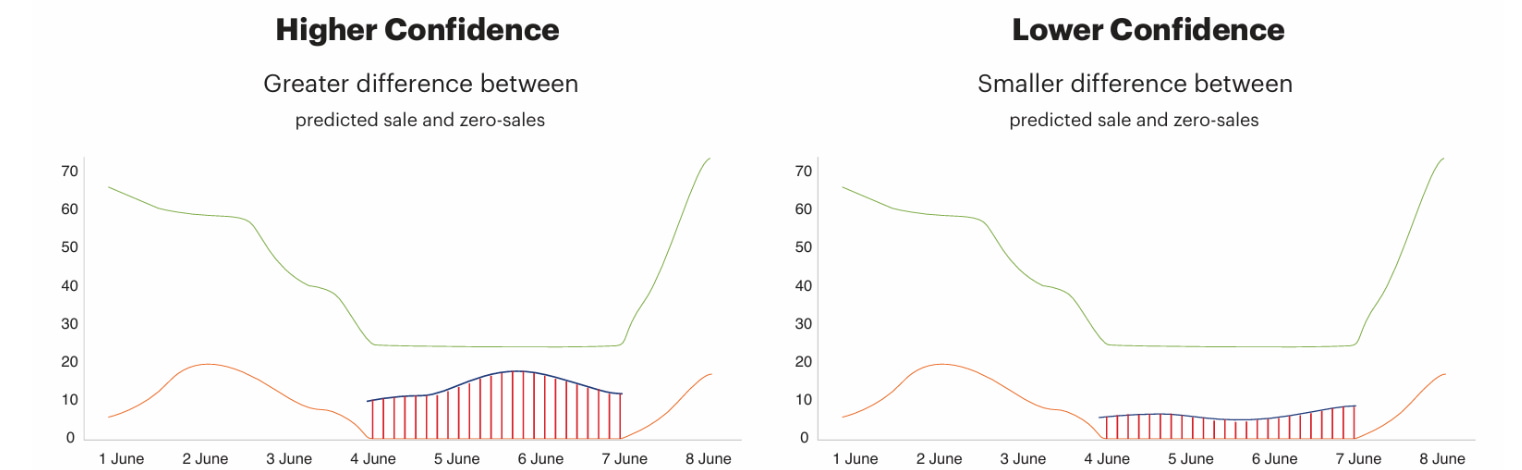
Now, there is always a natural probability of zero sale event occurring on a product which could be
independent of the inventory level that the store is holding.
We will brief upon the three approaches taken to bucket-ize the confidence we have in each instance,

**A high confidence factor **indicates that the zero sell-out behavior is a more likely to be anomaly which can be attributed to inventory accuracy issues

**A low confidence factor** indicates that the natural probability of zero sell-out behavior was highly expected and necessarily does not relate to inventory accuracy issues
## 4. Solution implementation and success story
In line with the functional responsibilities, key stakeholder and working groups involved in the solution
implementation and validation methodology are typically the (i) Key accounts management team (ii)
merchandising teams (iii) On-field sales teams (iv) Financial audit teams
Clearly, a white box solution approach described above needs to be taken through a Proof of Concept
phase and needs to be calibrated as per the business environment before becoming completely self
reliant.
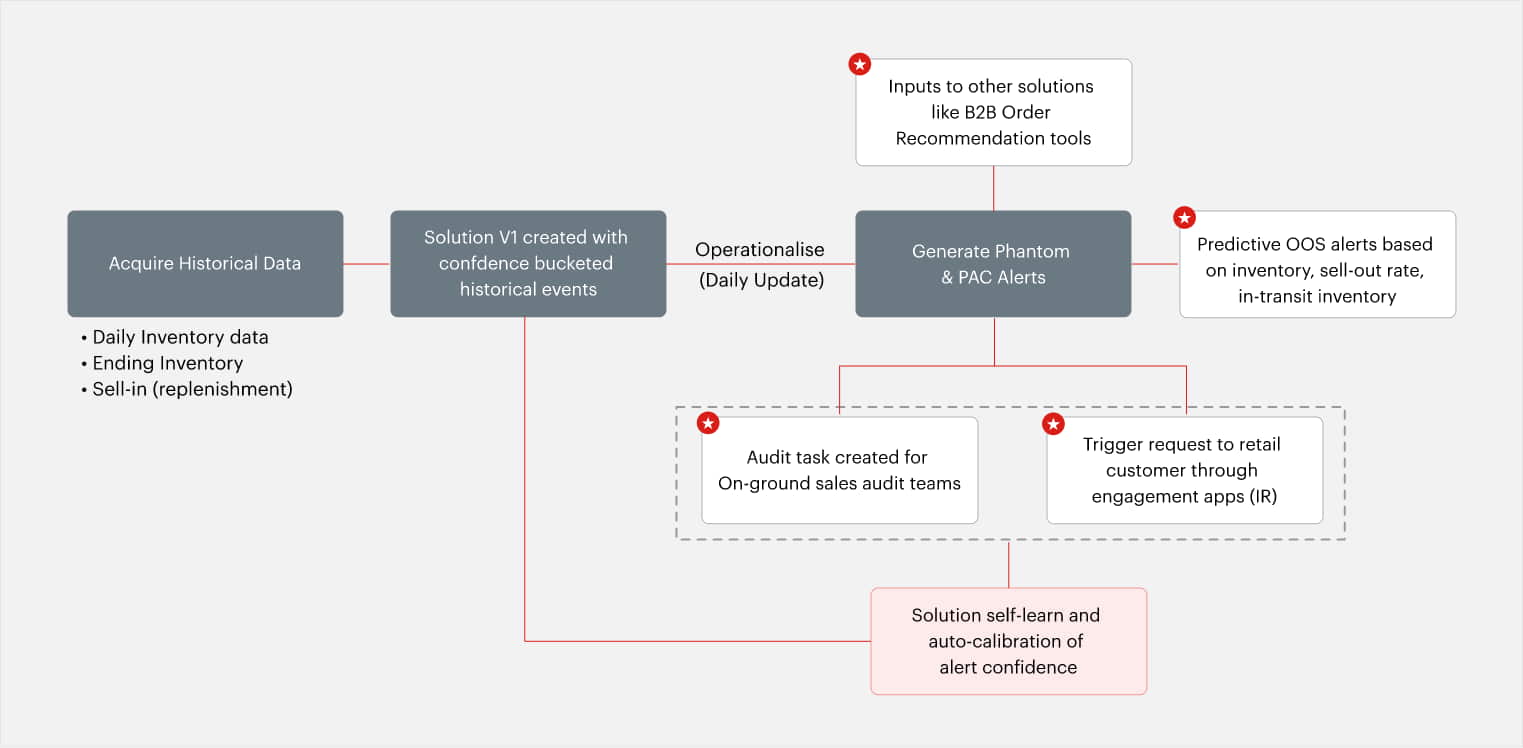
Large scale CPG retailers have on-ground sales audit teams (either in-house or outsourced) which can be
effectively used to cross-validate the solution observations, in addition to driving conversation with the
retailers about non-compliance events.
An illustrative workflow which would support the action and decision process is as follows,
The analysis was conducted for a global CPG giant (snacks and beverages), for their organized trade
channel
- Phantom & PAC instances were identified across **480** stores and **73** products
Out of total **~90,000** POS-product combinations in the network, we have this behavior present in
**~10,000** combinations
The analysis highlighted an annual opportunity of **$0.45 Mn **against studied annual sell-out of ~ $25
Mn in the portfolio & accounts in study (**1.8% **uplift)
Solution was operationalised for daily refresh, and provided daily alerts to sales team to conduct
audit / corrective actions in the market
### Validation of historical outputs
Using a historical sampling dataset available to the customer, we were able to validate the phantom OOS
observations using the “on-site” observations called out by the field agents team.
Within the store-SKU-date combinations against which the survey data was available,
For Phantom instances that were tagged “**High**” likelihood, **70%** of instances were validated by the
survey observations
For Phantom instances that were tagged “**Med**” likelihood, **50%** of instances were validated by the
survey observations
Or Phantom instances that were tagged “**Low**” likelihood, only **~25%** of instances were validated by
survey observations
## Conclusion
Maintaining accurate inventory records is a requirement to achieve a satisfactory level of [inventory optimization](/supply-chain-analytics/). What is not measured cannot be optimized; and when a measurement is made, it has to be accurate. Yet, our experience indicates that most retailers suffer from poor inventory accuracy in stores. RFID represents a potential long term solution to this situation, however even RFID cannot tell if a product is damaged, misplaced or inaccessible.
Businesses should tackle their inventory inaccuracies and ensure data reliability, before moving to
developing optimisation and recommendation solutions in the data ecosystem.
It goes without saying, that while the solution approach provides manufacturers with a tool to intelligently
identify opportunities in the network, the real values can be driven through trust and continued
collaboration between the manufacturer and the retailers.
## About the author
**Anurag Bhatia** has around 10 years of experience in Retail, CPG and Utilities space. Domain
exposure cuts across strategy, transformation and analytics capabilities setup for some of the
largest Fortune 500 organisations.
---
## Navigation
- [WordPress.org](https://wordpress.org/)
- [Documentation](https://wordpress.org/documentation/)
- [Learn WordPress](https://learn.wordpress.org/)
- [Support](https://wordpress.org/support/forums/)
- [Feedback](https://wordpress.org/support/forum/requests-and-feedback)
- [Sigmoid](https://www.sigmoid.com/)
- [Community](https://community.wpmanageninja.com/portal/space/fluent-forms/home)
- [Docs](https://wpmanageninja.com/docs/fluent-form/)
- [Developer Docs](https://developers.fluentforms.com/)
- [Documentation](https://imagify.io/documentation/)
- [Rate Imagify on WordPress.org](https://wordpress.org/support/view/plugin-reviews/imagify?rate=5#postform)
- [Manage](admin.php?page=litespeed)
- [Settings](admin.php?page=litespeed-cache)
- [Image Optimization](admin.php?page=litespeed-img_optm)
- [Company](/about-sigmoid)
- [Newsroom](/newsroom)
- [Life at Sigmoid](/careers)
- [Takshashila](/takshashila)
- [Contact Us](/contact-us)
- [AI Strategy Blueprint your AI advantage](/enterprise-ai-strategy/)
- [Generative AI Drive innovation with Generative AI](/generative-ai/)
- [Responsible AI Build trust with ethical AI practices](/responsible-ai-in-enterprise/)
- [Agentic AI Reshape business with scalable agentic systems](/agentic-ai-solutions/)
- [AI Managed Services Ensure reliable AI performance](/ai-managed-services/)
- [Advanced Analytics Transform your business with data-driven insights](/advanced-data-analytics-solutions/)
- [Start Assessment](/agentic-ai-readiness-index/)
- [Data Strategy Strong data foundations for scalable AI](/data-analytics-strategy/)
- [Data Management Leverage data as a strategic asset](/ai-data-management-services/)
- [Data Ops Automate data for speed and quality](/data-devops/)
- [Data Engineering Deliver insights faster with scalable pipelines](/data-engineering/)
- [Cloud Transformation Modernize data to maximise efficiency](/cloud-migration/)
- [Download Whitepaper](/ebooks-whitepapers/building-data-products-in-a-data-mesh-to-drive-business-value/)
- [Data Modeling Structure data for better decisions](/data-modeling-services/)
- [Data Visualization Transform data into actionable stories](/data-visualization-service/)
- [BI Migration Enhance decision making with modern BI tools](/bi-migration/)
- [Data Observability Build trust with healthy, accurate data](/data-observability/)
- [Automated Insights Make smarter decisions with auto-generated insights](/automated-insights/)
- [Download Whitepaper](/ebooks-whitepapers/power-bi-hacks/)
- [CPG & Retail End-to-end analytics for planning, operations, and commercial excellence](/industries/cpg-analytics/)
- [Life Sciences Trusted intelligence across clinical, commercial, and operational workflows](/industries/life-sciences/)
- [Financial Services AI-powered analytics for risk, compliance and customer experience](/industries/banking-financial-analytics-services/)
- [Read case study](/case-studies/data-clean-room-enables-real-time-insights-to-improve-operational-efficiency/)
- [MediaIQ Advanced platform for in-flight marketing measurement](/accelerators/sigmoid-mediaiq-multi-touch-attribution-tool/)
- [CampaignIQ AI-driven platform for optimized campaign budget allocation](/accelerators/sigmoid-campaigniq/)
- [AssistBot GenAI email assistant that automates human-like responses](/accelerators/sigmoid-assistbot-for-ai-email-assistant/)
- [CreativeBot GenAI tool for personalized and brand-aligned creative design](/accelerators/sigmoid-creativebot/)
- [SocialBot GenAI platform to analyze digital conversations and trends](/accelerators/#marketing|socialbot)
- [DemandIQ Predict trends accurately and optimize inventory management](/accelerators/sigmoid-demandiq/)
- [NetworkIQ Track and optimize logistics operations in real-time to quickly address disruptions](/accelerators/sigmoid-networkiq/)
- [SupplyIQ End-to-end platform to optimize supply chain operations](/accelerators/sigmoid-supplyiq/)
- [ProcurementIQ Automated procurement operations for maximum savings, compliance and efficiency](/accelerators/sigmoid-procurementiq/)
- [RapidML Accelerated deployment for machine learning models](/accelerators/sigmoid-rapidml/)
- [DataGuard Comprehensive platform for proactive data quality management](/accelerators/data-quality-tool-sigmoid-dataguard/)
- [CloudPulse Cloud cost optimization platform with multi-cloud management](/accelerators/sigmoid-cloudpulse/)
- [RAPID GenAI foundation with built-in governance and cost clarity](/accelerators/sigmoid-rapid/)
- [AnalyticsBot GenAI based platform to streamline decision-making in analytics](/accelerators/sigmoid-analyticsbot/)
- [DataConnect Seamlessly ingest, integrate and harmonize data from diverse sources](/accelerators/sigmoid-dataconnect/)
- [Reconica AI-powered data harmonization and reconciliation engine](/accelerators/sigmoid-reconica/)
- [ConverseBot GenAI driven insights generation for automated insights from reports](/accelerators/#sales|conversebot)
- [iNRM Cross-lever revenue growth optimization platform](/accelerators/sigmoid-inrm/)
- [AssortmentIQ Optimize shelf layouts and assortment mix at scale with AI-based insights](/accelerators/sigmoid-assortmentiq/)
- [Read Whitepaper](/ebooks-whitepapers/building-agentic-ai-chatbots-for-business-process-transformation/)
- [Listen Podcast](/events/podcast/how-jack-in-the-box-is-redefining-personalization-and-supply-chain-with-ai/)
- [Blogs](/blogs/)
- [White Papers](/ebooks-whitepapers/)
- [Case Studies](/case-studies/)
- [Podcast](/events/podcast/#Podcasts)
- [Read Blog](/blogs/the-genai-adoption-triad-responsibility-ethics-and-explainability/)
- [ConverseBot](/accelerators/#sales|conversebot/)
---
## Footer Links
- [Talk to our AI experts](/contact-us/)
- [AI Strategy](/enterprise-ai-strategy/)
- [Agentic AI](/agentic-ai-solutions/)
- [Generative AI](/generative-ai/)
- [AI Managed Services](/ai-managed-services/)
- [Responsible AI](/responsible-ai-in-enterprise/)
- [Advanced Analytics](/advanced-data-analytics-solutions/)
- [Data Strategy](/data-analytics-strategy//)
- [Data Engineering](/data-engineering/)
- [Data Management](/ai-data-management-services/)
- [Cloud Transformation](/cloud-transformation/)
- [Data Ops](/data-devops/)
- [Data Visualization](/data-visualization-service/)
- [Automated Insights](/automated-insights/)
- [BI Migration](/bi-migration/)
- [Data Modeling](/data-modeling-services/)
- [Data Observability](/data-observability/)
- [CPG & Retail](/industries/cpg-analytics/)
- [Financial Services](/industries/banking-financial-analytics-services/)
- [Life Sciences](/industries/life-sciences/)
- [Case Studies](/case-studies/)
- [Thought Leadership](/ebooks-whitepapers/)
- [Blogs](/blogs/)
- [Company](/about-sigmoid/)
- [Newsroom](/newsroom/)
- [Accelerators](/accelerators/)
- [Careers](/careers/)
- [Privacy Policy |](/privacy-policy/)
- [Cookie Policy](/cookie-policy/)