---
# Operationalizing GenAI in financial services for conversational reporting with Snowflake Cortex AI
**URL:** https://www.sigmoid.com/blogs/operationalizing-genai-in-financial-services-for-conversational-reporting-with-snowflake-cortex-ai/
Date: 2026-06-02
Author: Joha Momin
Post Type: post
Summary: Financial services has quickly become one of the most active industries for enterprise GenAI adoption. But across many organizations, the same challenge...Read More...
Categories: AI/ML
Tags: Analytics and Cognitive BI, Conversational Analytics, Data Engineering, Financial Services, Generative AI
Featured Image: https://www.sigmoid.com/wp-content/uploads/2026/06/Operationalizing-GenAI-in-financial-services-Banner.png
---
Financial services has quickly become one of the most active industries for enterprise GenAI adoption. But across many organizations, the same challenge keeps surfacing: strong pilot outcomes that struggle to scale once governance, data residency, explainability, and accuracy requirements enter the picture. The technology itself is no longer the limiting factor. The bigger challenge is figuring out how to drive reliable, [production-grade business value with GenAI](/generative-ai/) without compromising the trust and controls that financial services environments require.
Among the workflows where this gap shows up most clearly is business intelligence and analytics. Reporting sits at the center of how organizations consume and act on data every day. Yet many BI environments still rely heavily on static dashboards, analyst-led workflows, and slow turnaround times for new insights. As business conditions evolve faster and decision windows continue to shrink, that operating model is becoming increasingly difficult to sustain.
As GenAI platforms mature, the conversation is no longer whether to bring GenAI to the BI layer. It is how to make business analytics more conversational, self-service, and real-time without losing the governance, accuracy, and auditability that financial reporting demands.
## Where the BI bottleneck shows up in consumer finance
Across [financial services](/industries/banking-financial-analytics-services/), GenAI investments are largely centered around high-value areas such as customer service automation, fraud detection, document intelligence, compliance operations, and personalized advisory. Business intelligence is often discussed less frequently, but it may ultimately become one of the most transformative use cases. Every other GenAI use case eventually feeds into a decision, and most of those decisions still pass through a reporting workflow.
Consumer lending makes the case clearly. Credit risk exposure, delinquency trends, underwriting shifts, portfolio performance, and bureau signal changes directly influence portfolio strategy and lending decisions. These signals move quickly. A portfolio trend that appears stable at the beginning of the week can shift materially within days. But the reporting infrastructure at most consumer finance firms has not kept pace with this pace. Many organizations still depend on fixed dashboards built by centralized development teams, refreshed on scheduled cycles, and consumed passively by business users. When leaders need to investigate an unexpected trend or ask a new business question, the process often starts with a reporting request ticket instead of direct interaction with the data itself.
This creates four recurring challenges across consumer finance organizations:
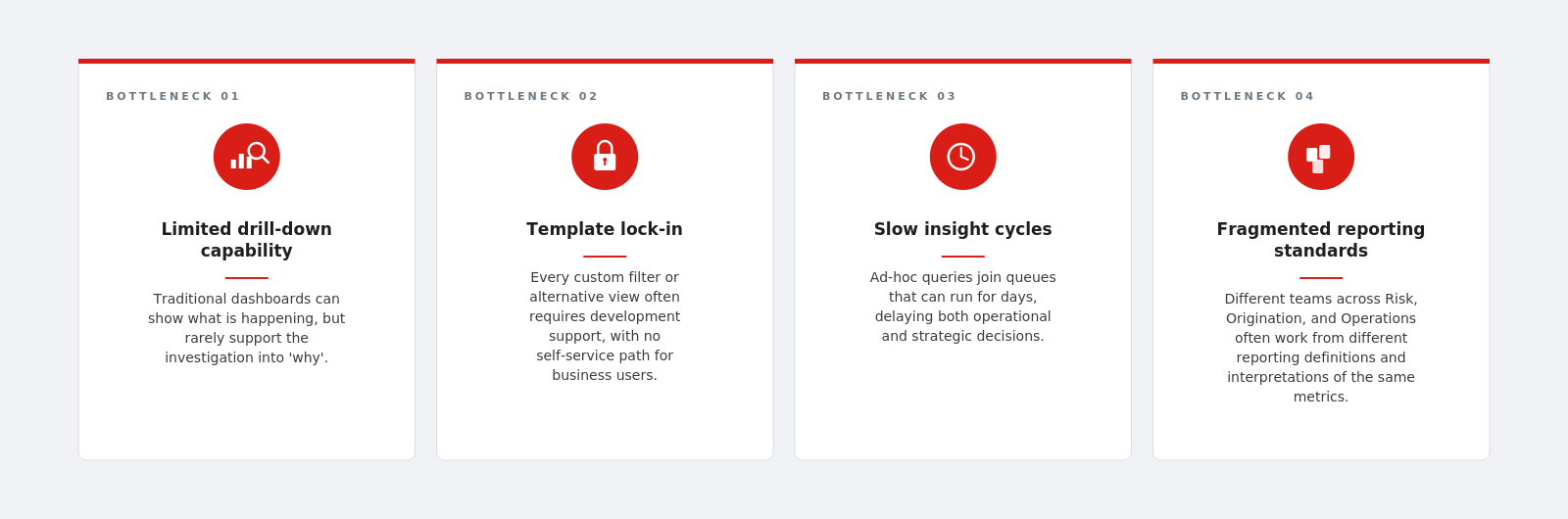
In non-prime consumer lending, where risk signals are nuanced and early identification of portfolio stress matters, these delays can carry real financial consequences.
## Why Snowflake Cortex AI changes the equation
Until recently, introducing GenAI into regulated reporting environments usually meant building separate inference layers outside the core data platform, routing sensitive financial data through external endpoints, and managing an entirely separate governance and security framework. For many financial institutions, that complexity alone was enough to keep GenAI initiatives stuck in pilot mode.
Snowflake Cortex AI changes that equation by bringing GenAI capabilities directly inside the governed Snowflake environment where enterprise data already resides. This significantly reduces the operational and compliance friction associated with deploying GenAI in financial services environments.
Key properties of the platform that make it a credible foundation for production-grade GenAI in BI, such as:
Property
Value-add
In-perimeter execution
All model inference runs within the Snowflake security boundary. For financial institutions with strict governance and data residency requirements, this removes one of the largest barriers to enterprise GenAI adoption. No data, even temporarily, can leave the platform.
Access to frontier models
Cortex AI provides serverless access to industry-leading LLMs including Anthropic Claude, OpenAI, Meta Llama, and Mistral Large 2. Organizations gain advanced reasoning capabilities without the operational burden of independently integrating and governing multiple model providers.
Built-in semantic and search capabilities
Capabilities such as Cortex Analyst, Cortex Search, and Cortex AI Functions simplify natural language querying, semantic retrieval, and multimodal data processing directly within the platform. This allows engineering teams to focus more on domain-specific accuracy and business logic instead of foundational infrastructure.
Native application hosting
Applications built using Streamlit can be deployed directly inside Snowflake, eliminating the need for separate hosting environments, fragmented identity systems, or disconnected audit trails. In regulated environments, that operational simplicity matters significantly.
## Case in point: A conversational reporting engine for a leading US consumer finance company
Technology capabilities alone do not create business value. The real differentiator is how effectively those capabilities are applied within a domain-specific business context. A recent Sigmoid engagement illustrates how conversational intelligence can be operationalized in a production financial services environment.
### Business requirements
The client, a leading US-based consumer finance company specializing in non-prime personal loans, already had a strong data foundation in place. Snowflake served as the organization’s centralized data platform, with governed pipelines ingesting data from loan origination systems, credit bureau feeds, and portfolio management environments. The underlying data quality was mature. What was missing was a faster and more intuitive way for business users to interact with that data. Risk and Origination teams needed the ability to investigate portfolio trends, perform root cause analysis, and generate custom views in real time without relying on IT-led reporting cycles.
The mandate was clear:
- Enable [natural language interaction with enterprise data](/automated-insights/)
- Support real-time investigative analysis across Risk and Origination workflows
- Preserve the organization’s governance posture on Snowflake
- Deliver production-grade accuracy within a highly domain-specific financial environment
### Solution: A four-layer system with a Dual Analyst routing brain
Sigmoid designed and implemented a [GenAI-powered conversational reporting engine](/blogs/conversational-bi-is-redefining-enterprise-decision-making/) built around four integrated functional layers, with a Dual Analyst routing framework at the center of the architecture.
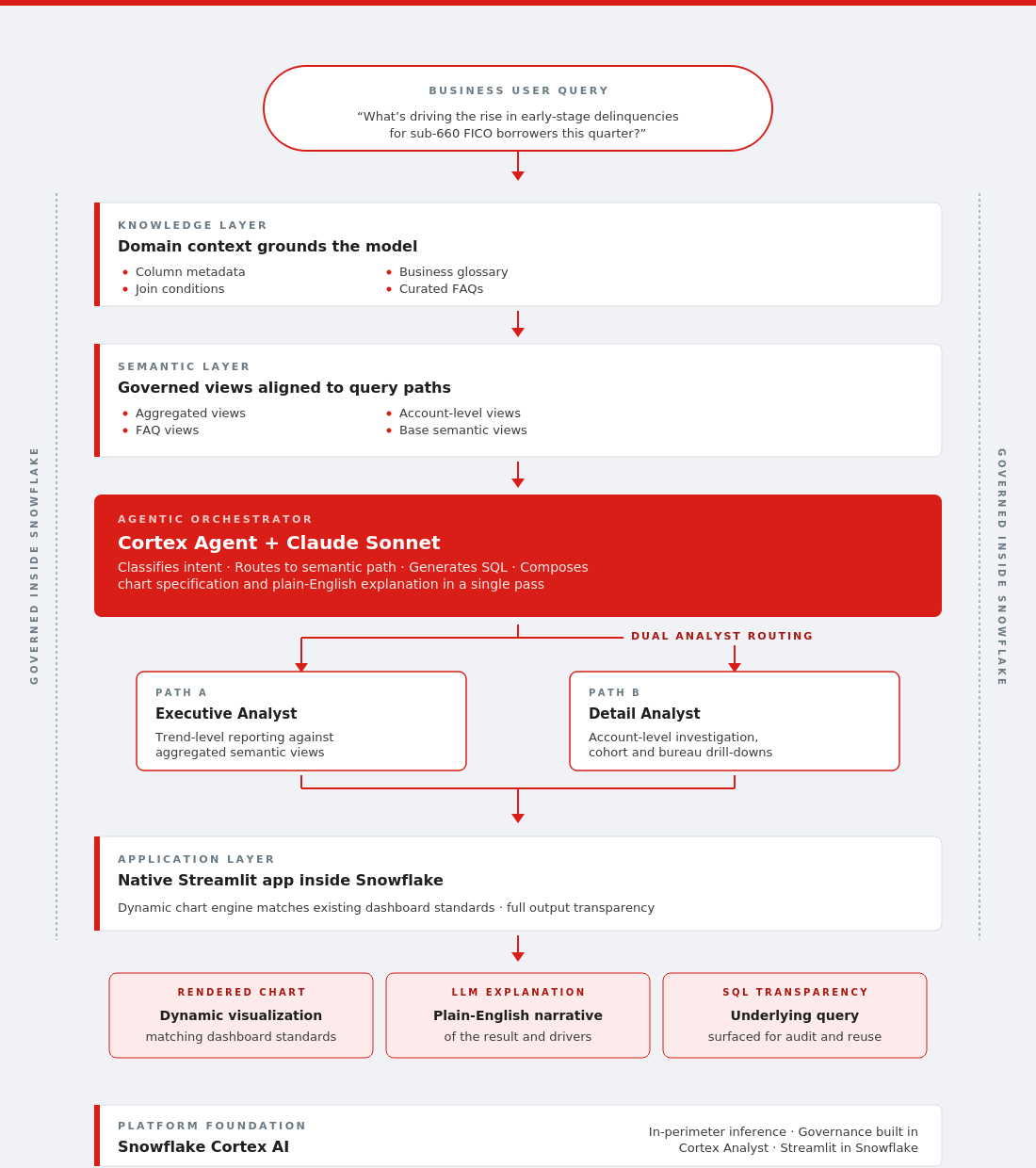
The core idea behind the solution was simple but important: not every business question should be treated the same way. An executive asking about portfolio-level trends requires a very different analytical path than a user investigating a specific account-level issue. Trying to answer both through a single retrieval approach often leads to weaker accuracy and limited contextual relevance. The Dual Analyst framework addresses this by automatically classifying query intent and routing requests through the most appropriate semantic pathway.
The Knowledge Layer forms the foundation. Built in close collaboration with the client’s data and business teams, this layer captures the contextual understanding required for accurate domain-specific reasoning. It includes column definitions, business glossary terms, join logic, valid filter values, and curated FAQs covering the most common Risk and Origination queries. This layer effectively teaches the LLM how to interpret the client’s data in the context of non-prime consumer lending. In practice, it became one of the most important contributors to response accuracy and trustworthiness.
Sitting above this is the Semantic Layer, which organizes governed views across four categories:
- Aggregated views for standardized trend reporting
- Account-level views for detailed investigation
- Preprocessed FAQ views for common query patterns
- Base semantic views for broader exploratory analysis
The Agentic Orchestrator, powered by Claude Sonnet through Cortex AI, sits at the heart of the system. The orchestrator classifies incoming query intent, routes requests to the appropriate semantic layer, generates SQL, creates chart specifications, and produces plain-English explanations in a single workflow. To ensure production-grade responsiveness, the architecture also incorporates caching and memory management techniques that maintain stable performance under concurrent enterprise query loads.
Finally, the Application Layer delivers the user experience through a Streamlit interface hosted directly within Snowflake. A Python-based chart replication layer ensures dynamically generated visualization remains visually consistent with the organization’s existing dashboards. Every query surfaces three outputs side by side: [the visualization, a natural language explanation, and the underlying SQL](/blogs/unlocking-data-intelligence-with-gen-ai-powered-sql-queries/).
### Business outcomes delivered
The solution is live in production, serving Risk and Origination teams across the client's personal loans business. The impact extended beyond measurable performance improvements. It also changed how analytics workflows operated across the organization.
Speed of insight
Self-service adoption
Architecture leverage
30 to 50% faster time-to-insight
across Risk and Origination queries, with root cause analysis reduced from days to seconds.
Zero IT tickets
for ad-hoc reporting or dashboard customization, with measurable improvement in analyst and stakeholder satisfaction.
Reusable semantic and charting modules
capable of supporting future Personal Loan use cases without rebuilding the architecture.
The organizational shift is arguably the bigger story. Analysts who previously spent significant time handling repetitive reporting requests were able to redirect that capacity toward higher-value analytical work. Business stakeholders no longer had to wait in reporting queues to investigate portfolio trends or operational issues. And because the semantic architecture and visualization layers were reusable, new use cases could be onboarded significantly faster than before.
## What this signals for the next wave of BI in financial services
This engagement reflects a broader shift already underway across financial services analytics, where Generative AI is steadily moving from experimentation into production-scale deployment. Business leaders can takeaway three big learnings:
- Conversational BI accuracy depends less on the LLM itself and more on the strength of the semantic, governance, and business context layers beneath it.
- Intelligent query routing and orchestration are becoming critical for delivering accurate, context-aware analytics experiences across different business users and workflows.
- The long-term [value of self-service BI](/case-studies/30-faster-access-to-trusted-data-through-marketplace/) lies in shifting analytics teams away from repetitive reporting toward faster decision-making and higher-value strategic analysis.
## Conclusion
The combination of governed in-platform AI services, frontier model access, and disciplined semantic engineering has turned conversational reporting from a future-state ambition into a present-day production capability in financial services. Organizations that move first will redirect analyst capacity toward the questions that matter most, give business teams a faster path from observation to decision, and build a foundation that compounds as new use cases land on the same architecture.
## About the author
**Ujjwal Agarwal** is a Partner Development Manager at Sigmoid. He brings over 8 years of hands-on experience as a Data Engineer across the Pharma and Banking industries. Combining technical depth with strategic partnership, he helps clients and cloud partners unlock the full potential of data and AI solutions for business process transformation. Ujjwal's cross-industry expertise enables him to drive meaningful collaboration and accelerate modernization initiatives for enterprises.
[lc_the_tags]
## Suggested readings
[View all](/blogs/)

#### Conversational BI is redefining enterprise decision-making
[Read blog](/blogs/conversational-bi-is-redefining-enterprise-decision-making/)

#### 6 BI Trends in 2026: Smarter, faster and AI-driven
[Read blog](/blogs/6-bi-trends-in-2026-smarter-faster-and-ai-driven/)

#### Unlocking data intelligence with gen AI-powered SQL queries
[Read blog](/blogs/unlocking-data-intelligence-with-gen-ai-powered-sql-queries/)
## Featured blogs
[lc_get_posts post_type="post"
posts_per_page="4" orderby="date" output_view="lc_get_posts_mycustom_view" output_number_of_columns="4"
output_wrapper_class="row" output_article_class="shadow" output_hide_elements="Excerpt"
output_excerpt_length="0" output_excerpt_text="Read More" output_heading_tag="span"
output_featured_image_format="thumbnail" output_featured_image_class="card-img-left" ]
## Share
[addtoany]
## Subscribe to get latest insights
## Talk to our experts
Get the best ROI with Sigmoid’s services in data engineering and AI
---
## Categories
- AI/ML
---
## Navigation
- [Company](/about-sigmoid)
- [Newsroom](/newsroom)
- [Life at Sigmoid](/careers)
- [Takshashila](/takshashila)
- [Contact Us](/contact-us)
- [AI Strategy Blueprint your AI advantage](/enterprise-ai-strategy/)
- [Generative AI Drive innovation with Generative AI](/generative-ai/)
- [Responsible AI Build trust with ethical AI practices](/responsible-ai-in-enterprise/)
- [Agentic AI Reshape business with scalable agentic systems](/agentic-ai-solutions/)
- [AI Managed Services Ensure reliable AI performance](/ai-managed-services/)
- [Advanced Analytics Transform your business with data-driven insights](/advanced-data-analytics-solutions/)
- [Download whitepaper](/ebooks-whitepapers/the-new-qsr-playbook-transforming-menu-strategy-into-a-growth-engine/)
- [Data Strategy Strong data foundations for scalable AI](/data-analytics-strategy/)
- [Data Management Leverage data as a strategic asset](/ai-data-management-services/)
- [DataOps Automate data for speed and quality](/data-devops/)
- [Forward Deployed Engineering Scale enterprise AI with FDEs & specialized agents](/forward-deployed-engineering/)
- [Data Engineering Deliver insights faster with scalable pipelines](/data-engineering/)
- [Cloud Transformation Modernize data to maximise efficiency](/cloud-migration/)
- [Download whitepaper](/ebooks-whitepapers/building-data-products-in-a-data-mesh-to-drive-business-value/)
- [Data Modeling Structure data for better decisions](/data-modeling-services/)
- [Data Visualization Transform data into actionable stories](/data-visualization-service/)
- [BI Migration Enhance decision making with modern BI tools](/bi-migration/)
- [Data Observability Build trust with healthy, accurate data](/data-observability/)
- [Automated Insights Make smarter decisions with auto-generated insights](/automated-insights/)
- [Download whitepaper](/ebooks-whitepapers/how-cognitive-bi-drives-an-intelligent-enterprise/)
- [CPG & Retail End-to-end analytics for planning, operations, and commercial excellence](/industries/cpg-analytics/)
- [Life Sciences Trusted intelligence across clinical, commercial, and operational workflows](/industries/life-sciences/)
- [Banking & Financial Services AI-powered analytics for risk, compliance and customer experience](/industries/banking-financial-analytics-services/)
- [Insurance Modernize core insurance platforms and unlock new revenue streams with AI](/industries/insurance-reimagined-with-ai/)
- [Download infographic](/wp-content/uploads/2026/03/Infographic_Maturity-Framework-for-Scaling-Agentic-AI.pdf)
- [Helios Turn marketing data into measurable business outcomes](/marketing-suite-helios/)
- [Stratos AI-powered platform for resilient supply chains](/supply-chain-stratos/)
- [DataGuard Agentic AI platform for data quality and governance](/data-quality-dataguard/)
- [MediaIQ Advanced platform for in-flight marketing measurement](/accelerators/sigmoid-mediaiq-multi-touch-attribution-tool/)
- [CampaignIQ AI-driven platform for optimized campaign budget allocation](/accelerators/sigmoid-campaigniq/)
- [AssistBot GenAI email assistant that automates human-like responses](/accelerators/sigmoid-assistbot-for-ai-email-assistant/)
- [CreativeBot GenAI tool for personalized and brand-aligned creative design](/accelerators/sigmoid-creativebot/)
- [SocialBot GenAI platform to analyze digital conversations and trends](/accelerators/#marketing|socialbot)
- [DemandIQ Predict trends accurately and optimize inventory management](/accelerators/sigmoid-demandiq/)
- [NetworkIQ Track and optimize logistics operations in real-time to quickly address disruptions](/accelerators/sigmoid-networkiq/)
- [SupplyIQ End-to-end platform to optimize supply chain operations](/accelerators/sigmoid-supplyiq/)
- [ProcurementIQ Automated procurement operations for maximum savings, compliance and efficiency](/accelerators/sigmoid-procurementiq/)
- [RapidML Accelerated deployment for machine learning models](/accelerators/sigmoid-rapidml/)
- [DataGuard Comprehensive platform for proactive data quality management](/accelerators/data-quality-tool-sigmoid-dataguard/)
- [CloudPulse Cloud cost optimization platform with multi-cloud management](/accelerators/sigmoid-cloudpulse/)
- [RAPID GenAI foundation with built-in governance and cost clarity](/accelerators/sigmoid-rapid/)
- [AnalyticsBot Conversational analytics for faster business decisions](/accelerators/sigmoid-analyticsbot/)
- [DataConnect Seamlessly ingest, integrate and harmonize data from diverse sources](/accelerators/sigmoid-dataconnect/)
- [Reconica AI-powered data harmonization and reconciliation engine](/accelerators/sigmoid-reconica/)
- [ConverseBot GenAI driven insights generation for automated insights from reports](/accelerators/#sales|conversebot)
- [iNRM Cross-lever revenue growth optimization platform](/accelerators/sigmoid-inrm/)
- [AssortmentIQ Optimize shelf layouts and assortment mix at scale with AI-based insights](/accelerators/sigmoid-assortmentiq/)
- [Read whitepaper](/ebooks-whitepapers/building-agentic-ai-chatbots-for-business-process-transformation/)
- [Listen Podcast](/events/podcast/how-jack-in-the-box-is-redefining-personalization-and-supply-chain-with-ai/)
- [Blogs](/blogs/)
- [White Papers](/ebooks-whitepapers/)
- [Case Studies](/case-studies/)
- [Podcast](/events/podcast/#Podcasts)
- [Download case study](/case-studies/ai-based-dynamic-targeting-and-personalized-hcp-engagement-for-pharma-marketing/)
- [ConverseBot](/accelerators/#sales|conversebot/)
## Tags
- Analytics and Cognitive BI
- Conversational Analytics
- Data Engineering
- Financial Services
- Generative AI
---
## Footer Links
- [Talk to our AI experts](/contact-us/)
- [AI Strategy](/enterprise-ai-strategy/)
- [Agentic AI](/agentic-ai-solutions/)
- [Generative AI](/generative-ai/)
- [AI Managed Services](/ai-managed-services/)
- [Responsible AI](/responsible-ai-in-enterprise/)
- [Advanced Analytics](/advanced-data-analytics-solutions/)
- [Data Strategy](/data-analytics-strategy//)
- [Data Engineering](/data-engineering/)
- [Data Management](/ai-data-management-services/)
- [Cloud Transformation](/cloud-transformation/)
- [DataOps](/data-devops/)
- [Forward Deployed Engineering](/forward-deployed-engineering/)
- [Data Visualization](/data-visualization-service/)
- [Automated Insights](/automated-insights/)
- [BI Migration](/bi-migration/)
- [Data Modeling](/data-modeling-services/)
- [Data Observability](/data-observability/)
- [CPG & Retail](/industries/cpg-analytics/)
- [Life Sciences](/industries/life-sciences/)
- [Banking & Financial Services](/industries/banking-financial-analytics-services/)
- [Insurance](/industries/insurance-reimagined-with-ai/)
- [Case Studies](/case-studies/)
- [Thought Leadership](/ebooks-whitepapers/)
- [Blogs](/blogs/)
- [Helios](/marketing-suite-helios/)
- [Stratos](/supply-chain-stratos/)
- [DataGuard](/data-quality-dataguard/)
- [Company](/about-sigmoid/)
- [Newsroom](/newsroom/)
- [Accelerators](/accelerators/)
- [Careers](/careers/)
- [Privacy Policy |](/privacy-policy/)
- [Cookie Policy](/cookie-policy/)