---
# The Green Fixture: Cutting IPL’s Carbon Footprint
**URL:** https://www.sigmoid.com/blogs/the-green-fixture-cutting-ipls-carbon-footprint/
Date: 2026-05-26
Author: Joha Momin
Post Type: post
Summary: 3,000 trees in just six minutes. That isn’t a miracle of nature; it’s a clinical maiden over in the IPL. In the...Read More...
Categories: AI/ML
Tags: AI/ML, ESG, Sustainability
Featured Image: https://www.sigmoid.com/wp-content/uploads/2026/05/The-Green-Fixture-Cutting-Featured-Image.jpg
---
3,000 trees in just six minutes. That isn’t a miracle of nature; it’s a clinical maiden over in the IPL. In the high-stakes theater of the IPL, the Green Dot Ball Initiative has turned defensive bowling into an environmental engine. For every dot ball bowled, the BCCI pledges 500 saplings. By the time a bowler finishes a scoreless six-ball over, they’ve effectively funded a small grove.
But while we celebrate these "Green Dots" on the scoreboard, the league faces a massive data irony. In its current 10-team format, the league’s 74 matches across 12+ cities create a "logistical ping-pong" where teams might fly from Chennai to Mohali and back to Bengaluru in a single week. This travel isn't just exhausting, it's ecologically expensive. A single cross-country flight for a squad of 30+ can emit more CO2 than an average Indian household does in six years, leaving a significant carbon trail across the subcontinent.
This blog presents a data driven scheduling model that reduces travel distances while preserving fairness and excitement, paving the way for a smarter, greener future for the IPL and global cricket.
## Why optimization is the key to scale sustainability
Optimization is more than just a buzzword; it’s the science of finding the absolute best solution within a maze of endless possibilities. In a complex ecosystem like the IPL, it serves as the master strategist, balancing competing goals and strict rules to deliver a result that works for the planet, the players, and the fans. An optimization model includes an objective function (The aim of objective function is either to minimize or maximize) and a set of constraints that must be followed. A solution is considered feasible if it satisfies all constraints, and optimal if it also yields the best value for the objective.
There are two major types of optimization techniques:
- Linear Programming (LP): Solves problems with linear relationships using methods like the simplex algorithm or solvers like GLOP and SCIP.
- Constraint Programming (CP): Focuses on narrowing down the search space using logical rules, typically solved using CP-SAT solver.
## IPL’s scheduling issue
The current IPL fixture structure ensures competitive balance but results in extensive cross country travel, creating strain on players, increasing logistical complexity, and contributing significantly to carbon emissions. With matches spread across multiple cities and tight timelines, teams face limited recovery windows and frequent long distance movement, making scheduling efficiency a growing concern for both performance and sustainability.
This work focuses on optimizing the existing fixture by reducing overall travel while preserving fairness, competitiveness, and operational feasibility. Instead of redesigning the schedule entirely, the approach introduces controlled adjustments within defined limits, supported by a sliding window to maintain proximity to the original plan. It also incorporates realistic travel patterns and safeguards rest intervals, ensuring a practical, player friendly, and environmentally responsible scheduling model.
## Solution methodology
The inputs needed to design this solution are as follows:
- Current/Previous Year fixture
- Each team’s home venue(s) (Some team might have multiple home venues) and initial location
- Match count per venue
- First match-up and its venue
- Sliding window size
- Min/max rest between matches
- Max days away from home
- Number of match days
- CO2 emission per passenger per km (Assumed to be 246 gram per passenger per km based on source)
- Number of members (player & support staff) for each team (Assumed to be 25 for each team)
The solution is built using a **Constraint Programming (CP)** and is structured into two sequential models:
### Model 1: Minimize total travel distance (i.e. Total CO2 emissions)
- Starts with the current IPL fixture.
- Adjusts the match-up sequence to reduce total travel across all teams.
- Uses the Haversine formula to compute travel distances between cities based on GPS coordinates.
- Teams can play consecutive away games and do not have to return home between each match, but cannot stay away from home for more than a set number of days.
- The first match is fixed, based on IPL tradition.
- Introduces a sliding window - An idea that restricts how far any match can move from its original slot, drastically reducing the number of combinations to evaluate.
### Model 2: Maximize gap between consecutive matches for each team
- Model formulation is the same as Model 1 except the objective function.
- Initializes its decision variables using output values from Model 1 to speed up convergence and reduce computational effort.
- Focuses on increasing the average rest period between a team’s matches without violating fixture or travel constraints
### Key decision variables
- **Match Assignment**: Binary variable indicating if a match-up is scheduled on a specific day.
- **Team Location**: Binary variable tracking each team’s location on each day.
- **Gap Calculation**: Continuous variable for the number of days between each team's matches.
### Key constraints
- Each match-up is played once, on exactly one day.
- Matches must occur within the allowed sliding window from their original position.
- Teams can be in only one location per day.
- Teams don’t move cities unless they have a match.
- Each venue hosts a predefined number of matches.
- On weekdays: 1 match/day; weekends: up to 2 matches; each day has at least one match.
- The first match and its venue are fixed.
- Minimum and maximum rest days between matches for each team are enforced.
- Max days away from home per team is limited to 10 days.
- The average rest gap across all teams must be greater than or equal to the current fixture's average.
## Results
### Experimental insights & recommendations
The model was run using different parameter settings (e.g., sliding window sizes from 6 to 14 and minimum rest gaps of 2 or 3 days). The maximum allowable days away from home was 10 and the maximum rest gap was also capped at 10 days.
Below chart compares CO₂ emissions from the current IPL fixture to model generated fixtures. The percentages shown represent the CO₂ emission drop relative to the current IPL fixture. A 2 day minimum rest gap yields lower emissions than a 3 day gap. The lowest emissions (**15.3% less than the current fixture**) occur with a sliding window of 14 days under the **2 day rest gap** setting. For the **3 day rest gap**, emissions are minimized at sliding windows of 10, 12, and 14 days (**4.5% less than the current fixture**).
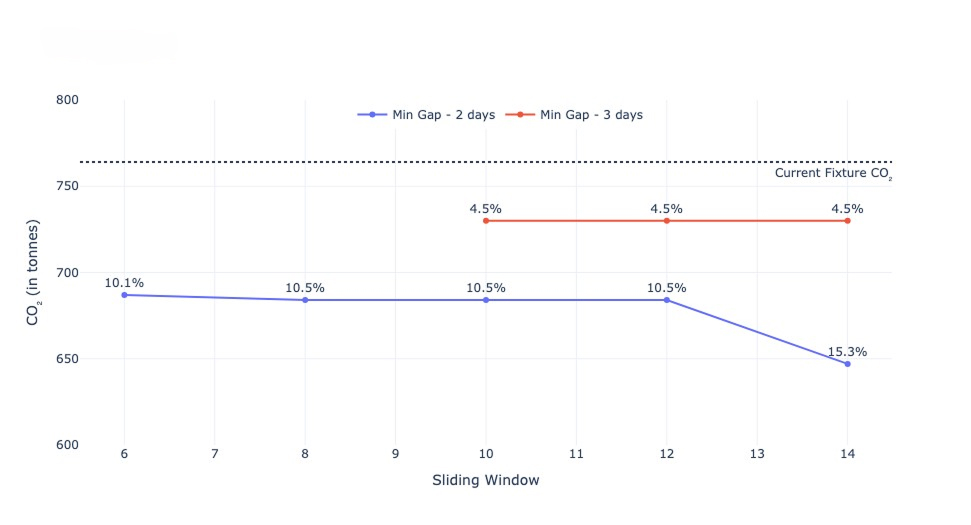
Fig. 1. CO2 Emissions
Below chart compares the average gap between matches in the current IPL fixture and the model generated fixtures. For the 2 day gap setting, the model matches for the current fixture value while for 3 day gap setting, there is a longer average gap indicating that players have more recovery time and are likely to be better prepared for upcoming matches.
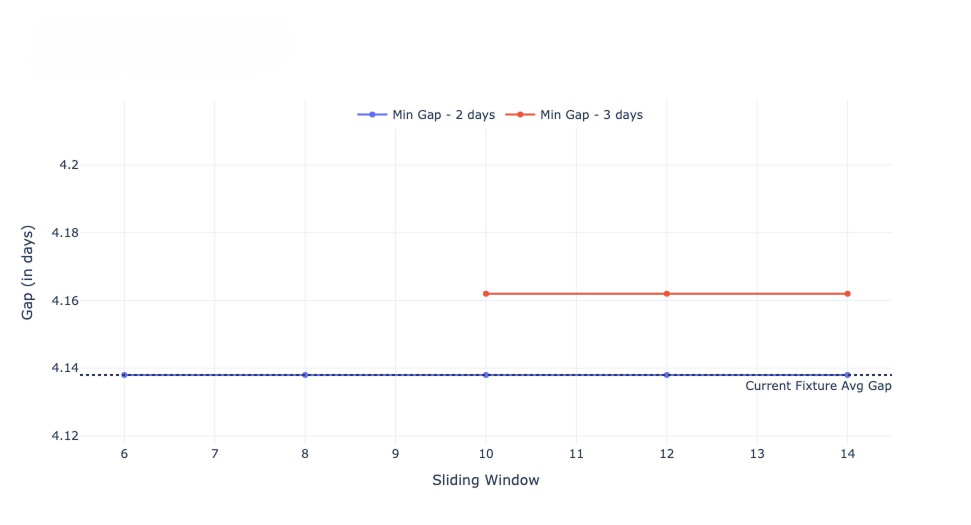
Fig. 2. Avg Gap between Matches
This visual compares the total distance travelled by all teams in the current fixture versus the two best model recommended fixtures (2 day rest with sliding window 14 and 3 day rest with window 14). Model generated fixtures have lower values relative to the current IPL fixture. Percentages indicate the distance reduction relative to the current IPL fixture.
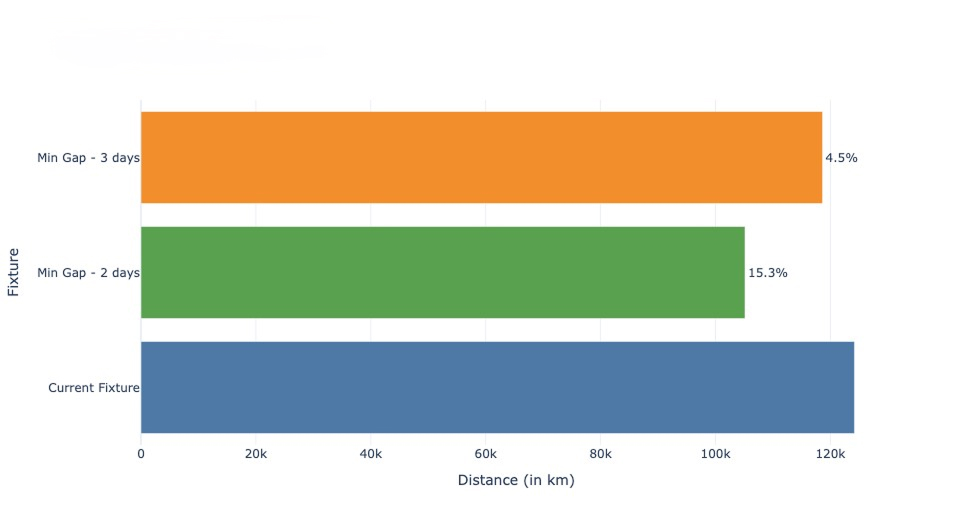
Fig. 3. Distance Travelled by each Team
This visual compares the total distance travelled by each team in the current fixture versus the two best model recommended fixtures (2 day rest with sliding window 14 and 3 day rest with window 14). Most teams travel less in the model-generated fixtures. Percentages indicate the distance reduction relative to the current IPL fixture.
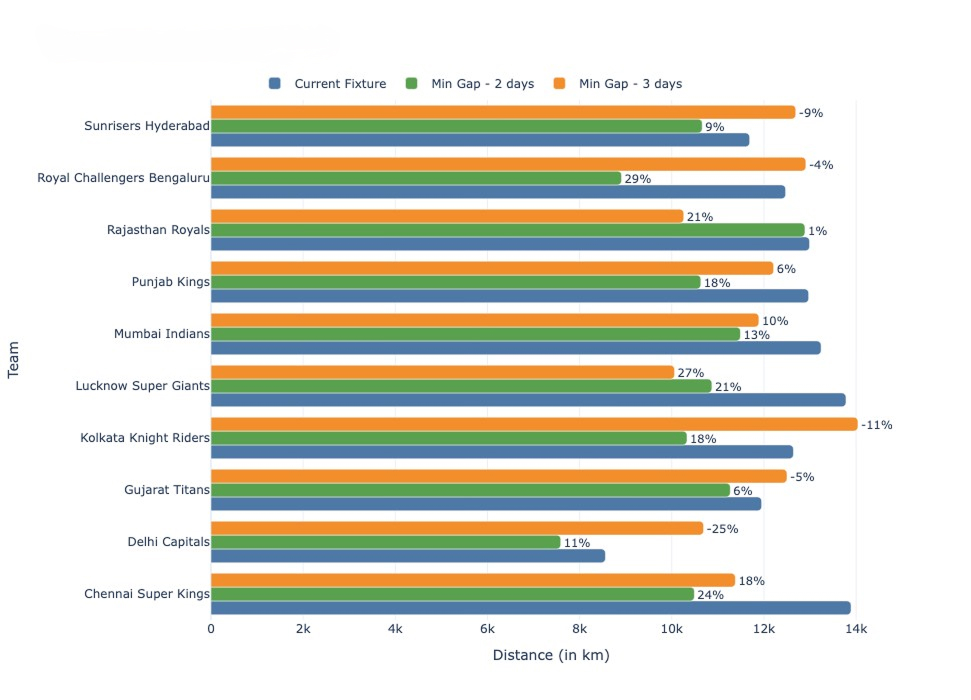
Fig. 4. Distance Travelled by each Team
See the appendix section for the complete IPL schedule
### Runtime & execution environment
To balance quality and computational efficiency, each combination of input parameters was evaluated under time limited runs:
- **Model 1 (Minimize Travel Distance/CO2 Emissions)**: Run for **10 minutes**
- **Model 2 (Maximize Rest Gap)**: Run for **5 minutes**
- **Machine Used**: Apple MacBook M1 (8GB RAM)
Although the solutions did not guarantee global optimality, they **consistently outperformed the existing fixture** in both travel efficiency and player rest balance. The time limits were deliberately chosen to **simulate real world constraints**, such as fast fixture generation needs during tournament planning or dynamic rescheduling scenarios. This makes the approach not only effective but also **practical and scalable** for actual IPL operations.
## Conclusion
This paper introduces an intelligent fixture optimization approach that reduces total travel and CO2 emissions (**15.3% - from 764 to 647 tons of CO2**) in the IPL. The use of constraint programming combined with a sliding window strategy ensures computational efficiency without sacrificing realism. Results show measurable gains over the existing fixture, despite constrained computing time. A web application (see Appendix section for screen recording) is also created (using Streamlit) which reinforces the model’s practicality, offering decision-makers a fast, flexible tool for sustainable scheduling. This method has the potential to influence fixture planning in other global sporting events.
## About the author
**Nitish Sawant** is a Lead Data Scientist with 6+ years of experience building enterprise-scale AI, optimization, simulation, and GenAI-driven decision systems across supply chain, manufacturing, pharma, and consumer goods domains. Strong expertise in mathematical optimization, multi-agent AI systems, RAG architectures, semantic search, and simulation modeling using Python, OR-Tools, LangChain, LangGraph, SimPy, and modern cloud-native application stacks. Experienced in delivering scalable AI solutions for leading global enterprises through close collaboration with product, engineering, DevOps, data engineering, and QA teams. Passionate about solving complex operational problems using applied AI, operations research, and intelligent automation.
[lc_the_tags]
## Suggested readings
[View all](/blogs/)

#### The GenAI adoption triad: Responsibility, Ethics, and Explainability
[Read blog](/blogs/the-genai-adoption-triad-responsibility-ethics-and-explainability/)

#### Rise of Agentic AI in supply chain networks for consumer goods
[Read blog](/blogs/rise-of-agentic-ai-enabled-supply-chain-networks-in-consumer-goods/)

#### CPG R&D: The next big opportunity for AI-led digital transformation
[Read blog](/blogs/cpg-rd-the-next-big-opportunity-for-ai-led-digital-transformation/)
## Featured blogs
[lc_get_posts post_type="post"
posts_per_page="4" orderby="date" output_view="lc_get_posts_mycustom_view" output_number_of_columns="4"
output_wrapper_class="row" output_article_class="shadow" output_hide_elements="Excerpt"
output_excerpt_length="0" output_excerpt_text="Read More" output_heading_tag="span"
output_featured_image_format="thumbnail" output_featured_image_class="card-img-left" ]
## Share
[addtoany]
## Subscribe to get latest insights
## Talk to our experts
Get the best ROI with Sigmoid’s services in data engineering and AI
---
## Categories
- AI/ML
---
## Navigation
- [Company](/about-sigmoid)
- [Newsroom](/newsroom)
- [Life at Sigmoid](/careers)
- [Takshashila](/takshashila)
- [Contact Us](/contact-us)
- [AI Strategy Blueprint your AI advantage](/enterprise-ai-strategy/)
- [Generative AI Drive innovation with Generative AI](/generative-ai/)
- [Responsible AI Build trust with ethical AI practices](/responsible-ai-in-enterprise/)
- [Agentic AI Reshape business with scalable agentic systems](/agentic-ai-solutions/)
- [AI Managed Services Ensure reliable AI performance](/ai-managed-services/)
- [Advanced Analytics Transform your business with data-driven insights](/advanced-data-analytics-solutions/)
- [Download whitepaper](/ebooks-whitepapers/the-new-qsr-playbook-transforming-menu-strategy-into-a-growth-engine/)
- [Data Strategy Strong data foundations for scalable AI](/data-analytics-strategy/)
- [Data Management Leverage data as a strategic asset](/ai-data-management-services/)
- [DataOps Automate data for speed and quality](/data-devops/)
- [Forward Deployed Engineering Scale enterprise AI with FDEs & specialized agents](/forward-deployed-engineering/)
- [Data Engineering Deliver insights faster with scalable pipelines](/data-engineering/)
- [Cloud Transformation Modernize data to maximise efficiency](/cloud-migration/)
- [Download whitepaper](/ebooks-whitepapers/building-data-products-in-a-data-mesh-to-drive-business-value/)
- [Data Modeling Structure data for better decisions](/data-modeling-services/)
- [Data Visualization Transform data into actionable stories](/data-visualization-service/)
- [BI Migration Enhance decision making with modern BI tools](/bi-migration/)
- [Data Observability Build trust with healthy, accurate data](/data-observability/)
- [Automated Insights Make smarter decisions with auto-generated insights](/automated-insights/)
- [Download whitepaper](/ebooks-whitepapers/how-cognitive-bi-drives-an-intelligent-enterprise/)
- [CPG & Retail End-to-end analytics for planning, operations, and commercial excellence](/industries/cpg-analytics/)
- [Life Sciences Trusted intelligence across clinical, commercial, and operational workflows](/industries/life-sciences/)
- [Banking & Financial Services AI-powered analytics for risk, compliance and customer experience](/industries/banking-financial-analytics-services/)
- [Insurance Modernize core insurance platforms and unlock new revenue streams with AI](/industries/insurance-reimagined-with-ai/)
- [Download infographic](/wp-content/uploads/2026/03/Infographic_Maturity-Framework-for-Scaling-Agentic-AI.pdf)
- [Helios Turn marketing data into measurable business outcomes](/marketing-suite-helios/)
- [Stratos AI-powered platform for resilient supply chains](/supply-chain-stratos/)
- [DataGuard Agentic AI platform for data quality and governance](/data-quality-dataguard/)
- [MediaIQ Advanced platform for in-flight marketing measurement](/accelerators/sigmoid-mediaiq-multi-touch-attribution-tool/)
- [CampaignIQ AI-driven platform for optimized campaign budget allocation](/accelerators/sigmoid-campaigniq/)
- [AssistBot GenAI email assistant that automates human-like responses](/accelerators/sigmoid-assistbot-for-ai-email-assistant/)
- [CreativeBot GenAI tool for personalized and brand-aligned creative design](/accelerators/sigmoid-creativebot/)
- [SocialBot GenAI platform to analyze digital conversations and trends](/accelerators/#marketing|socialbot)
- [DemandIQ Predict trends accurately and optimize inventory management](/accelerators/sigmoid-demandiq/)
- [NetworkIQ Track and optimize logistics operations in real-time to quickly address disruptions](/accelerators/sigmoid-networkiq/)
- [SupplyIQ End-to-end platform to optimize supply chain operations](/accelerators/sigmoid-supplyiq/)
- [ProcurementIQ Automated procurement operations for maximum savings, compliance and efficiency](/accelerators/sigmoid-procurementiq/)
- [RapidML Accelerated deployment for machine learning models](/accelerators/sigmoid-rapidml/)
- [DataGuard Comprehensive platform for proactive data quality management](/accelerators/data-quality-tool-sigmoid-dataguard/)
- [CloudPulse Cloud cost optimization platform with multi-cloud management](/accelerators/sigmoid-cloudpulse/)
- [RAPID GenAI foundation with built-in governance and cost clarity](/accelerators/sigmoid-rapid/)
- [AnalyticsBot Conversational analytics for faster business decisions](/accelerators/sigmoid-analyticsbot/)
- [DataConnect Seamlessly ingest, integrate and harmonize data from diverse sources](/accelerators/sigmoid-dataconnect/)
- [Reconica AI-powered data harmonization and reconciliation engine](/accelerators/sigmoid-reconica/)
- [ConverseBot GenAI driven insights generation for automated insights from reports](/accelerators/#sales|conversebot)
- [iNRM Cross-lever revenue growth optimization platform](/accelerators/sigmoid-inrm/)
- [AssortmentIQ Optimize shelf layouts and assortment mix at scale with AI-based insights](/accelerators/sigmoid-assortmentiq/)
- [Read whitepaper](/ebooks-whitepapers/building-agentic-ai-chatbots-for-business-process-transformation/)
- [Listen Podcast](/events/podcast/how-jack-in-the-box-is-redefining-personalization-and-supply-chain-with-ai/)
- [Blogs](/blogs/)
- [White Papers](/ebooks-whitepapers/)
- [Case Studies](/case-studies/)
- [Podcast](/events/podcast/#Podcasts)
- [Download case study](/case-studies/ai-based-dynamic-targeting-and-personalized-hcp-engagement-for-pharma-marketing/)
- [ConverseBot](/accelerators/#sales|conversebot/)
## Tags
- AI/ML
- ESG
- Sustainability
---
## Footer Links
- [Talk to our AI experts](/contact-us/)
- [AI Strategy](/enterprise-ai-strategy/)
- [Agentic AI](/agentic-ai-solutions/)
- [Generative AI](/generative-ai/)
- [AI Managed Services](/ai-managed-services/)
- [Responsible AI](/responsible-ai-in-enterprise/)
- [Advanced Analytics](/advanced-data-analytics-solutions/)
- [Data Strategy](/data-analytics-strategy//)
- [Data Engineering](/data-engineering/)
- [Data Management](/ai-data-management-services/)
- [Cloud Transformation](/cloud-transformation/)
- [DataOps](/data-devops/)
- [Forward Deployed Engineering](/forward-deployed-engineering/)
- [Data Visualization](/data-visualization-service/)
- [Automated Insights](/automated-insights/)
- [BI Migration](/bi-migration/)
- [Data Modeling](/data-modeling-services/)
- [Data Observability](/data-observability/)
- [CPG & Retail](/industries/cpg-analytics/)
- [Life Sciences](/industries/life-sciences/)
- [Banking & Financial Services](/industries/banking-financial-analytics-services/)
- [Insurance](/industries/insurance-reimagined-with-ai/)
- [Case Studies](/case-studies/)
- [Thought Leadership](/ebooks-whitepapers/)
- [Blogs](/blogs/)
- [Helios](/marketing-suite-helios/)
- [Stratos](/supply-chain-stratos/)
- [DataGuard](/data-quality-dataguard/)
- [Company](/about-sigmoid/)
- [Newsroom](/newsroom/)
- [Accelerators](/accelerators/)
- [Careers](/careers/)
- [Privacy Policy |](/privacy-policy/)
- [Cookie Policy](/cookie-policy/)