---
# How CPG brands can connect digital intelligence with store execution
**URL:** https://www.sigmoid.com/blogs/how-cpg-brands-can-connect-digital-intelligence-with-store-execution/
Date: 2026-07-17
Author: Joha Momin
Post Type: post
Summary: Key takeaways Bringing digital-style precision to physical retail depends on data foundations and operating models, not new AI tools. “Media to shelf”...Read More...
Categories: AI/ML
Tags: Advanced Analytics, AI, CPG, Digital Transformation, In-store Execution, Retail Media
Featured Image: https://www.sigmoid.com/wp-content/uploads/2026/07/How-CPG-brands-can-connect-digital-intelligence-with-store-execution-Blog-image.jpg
---
## Key takeaways
- Bringing digital-style precision to physical retail depends on data foundations and operating models, not new AI tools.
- "Media to shelf" aligns marketing, sales, supply chain, and retail partners around one consumer outcome.
- Precision targeting, built for digital, can be applied to physical geography through granular, overlapping signals.
- Winning the "valley" periods between demand peaks depends on granularity at scale, not thousands of unique plans.
- Fixing the operating model, not adding more data, is what turns signals into coordinated retail execution.
- Progress beats perfection: lasting advantage comes from combining intelligence, execution, retailer alignment, and human collaboration.
Digital commerce has raised the standard for precision, personalization, and real-time optimization. But for CPG companies, the bigger opportunity lies in bringing that same intelligence into physical retail, where consumer engagement, retail execution, and purchase decisions ultimately converge.
The challenge is not the lack of data or advanced analytics. It is the ability to connect consumer signals with store-level decisions, align teams across functions, and build operating models that can turn insights into action.
In the *latest episode of Reimagine with AI*, guest Jeff Swearingen, Founder of Dichotomy Solutions, LLC and former PepsiCo executive, explores what it takes to make physical retail more responsive and explains why the next wave of [CPG growth](/industries/cpg-analytics/) relies on bridging digital precision with real-world execution. Drawing on his deep experience in building enterprise AI analytics and leading large-scale retail transformations, Swearingen shares how CPG organizations can successfully connect media, data, and shelf execution to deliver greater value for both consumers and retail partners.
## The moment “big data” became a business mandate
The shift toward more intelligent retail execution started long before today’s AI acceleration. Around 2013-2014, it became clear that big data, machine learning, and early AI and [advanced data analytics solutions](/advanced-data-analytics-solutions/) would fundamentally reshape retail and CPG.
The companies that moved early were not simply chasing new technology. They made intentional bets, collaborated deeply with retailers, studied adjacent industries, and identified how emerging capabilities could create measurable business impact.
One of the biggest lessons from this period was that technology adoption was only one part of the transformation. Building models and platforms was challenging, but changing how large organizations planned, collaborated, and executed was far more complex.
That lesson continues to define AI adoption today. Competitive advantage depends not just on generating better insights, but on creating the organizational capability to act on them.
## Why “media to shelf” became the North Star
For CPG companies, the biggest opportunity lies in connecting the demand they create with the experiences they deliver.
Marketing investments can influence consumers with increasingly personalized messaging. But if those consumers reach the store and the product is unavailable, poorly positioned, or disconnected from the message they received, the experience breaks.
This is where the concept of “media to shelf” becomes critical. It connects upstream consumer engagement with [downstream retail execution](/case-studies/smart-in-store-execution-platform-boosts-sales-by-3/), ensuring that distribution, shelf presence, promotion, and availability support the demand being generated. The alignment creates a shared operating model where marketing, sales, supply chain, and retail partners work toward the same consumer outcome.
At this point, analytics moves beyond improving targeting. It becomes a way to create better experiences and stronger partnerships between brands and retailers.
## Precision targeting isn’t just for digital anymore
Delivering on the promise of media-to-shelf requires understanding demand at a much more granular level.
It starts by connecting different signals such as:
- Who lives, works, or moves through a geography
- What motivates different consumer groups
- Which retail environments influence buying decisions
- How local factors shape demand
By overlaying these signals, CPG companies can better identify where consumers are most likely to become shoppers and what actions can improve conversion.
Some of the most valuable insights come from unexpected patterns within data. For example, adjacent or “marker” categories can reveal hidden demand signals when they strongly correlate with another product’s performance. These patterns help organizations identify areas of latent demand and understand where targeted actions can create incremental growth.
The real shift is moving from analyzing what happened to determining what should happen next: which products to prioritize, where to activate media, and how to create more relevant consumer experiences.
## Winning in the valleys matters more than winning at the peaks
Most organizations know how to prepare for predictable demand peak moments such as seasonal spikes, holidays, or major consumption occasions. But the harder opportunity is creating demand outside those moments. Winning during these ‘valley’ periods requires understanding how consumer motivations change week by week, market by market, and translating those insights into action.
This requires what Jeff describes as granularity at scale.
The objective is not to create thousands of unique execution plans that become impossible to manage. It is to find the right clusters of consumers, markets, and opportunities where companies can act with greater precision while maintaining scalability.
AI can reveal increasingly granular opportunities, but sustainable impact depends on balancing analytical precision with operational execution.
## Fix the operating model before adding more data
Many organizations have access to sophisticated analytics and digital signals. The challenge is converting those signals into coordinated action across the physical retail ecosystem. Physical retail operates differently from digital channels. A digital [media campaign](/accelerators/sigmoid-mediaiq-multi-touch-attribution-tool/) can be optimized almost instantly, but changing assortment, shelf presence, or retail execution requires coordination across different teams, timelines, and partners.
Bridging this gap requires strong fundamentals that include:
- Clear operating models
- Disciplined planning processes
- Retailer collaboration
- Aligned incentives and success metrics
It also requires clarity and focus. As Jeff highlights, strategy involves making deliberate choices about what to prioritize and what to leave behind. The organizations that succeed are those that build the systems, partnerships, and behaviors needed to consistently turn intelligence into action.
## Momentum is what sustains transformation
As [AI becomes more embedded across the enterprise](/enterprise-ai-strategy/), transformation increasingly depends on how effectively people work together. Large-scale change requires different teams to carry ideas from strategy to execution. But handoffs often fail when teams focus only on completing their part instead of ensuring the next team can succeed.
Jeff compares this to passing a baton in a relay race. The responsibility does not end when the baton leaves your hand; it ends when the next person successfully receives it. That requires listening, understanding incentives, and building solutions that reflect what teams actually need.
In increasingly complex organizations, leaders must become ‘functionally multilingual’ who are deep experts in their own areas while being fluent enough across other areas to connect teams and accelerate change.
## Progress beats perfection in the age of AI
As AI capabilities evolve rapidly, many organizations wait for the perfect data foundation, technology stack, or operating environment before moving forward. But in CPG, perfection often slows progress. The question is whether organizations are making better decisions today than yesterday and whether they are learning fast enough to continuously improve.
For large enterprises navigating AI transformation, the path forward often looks like this:
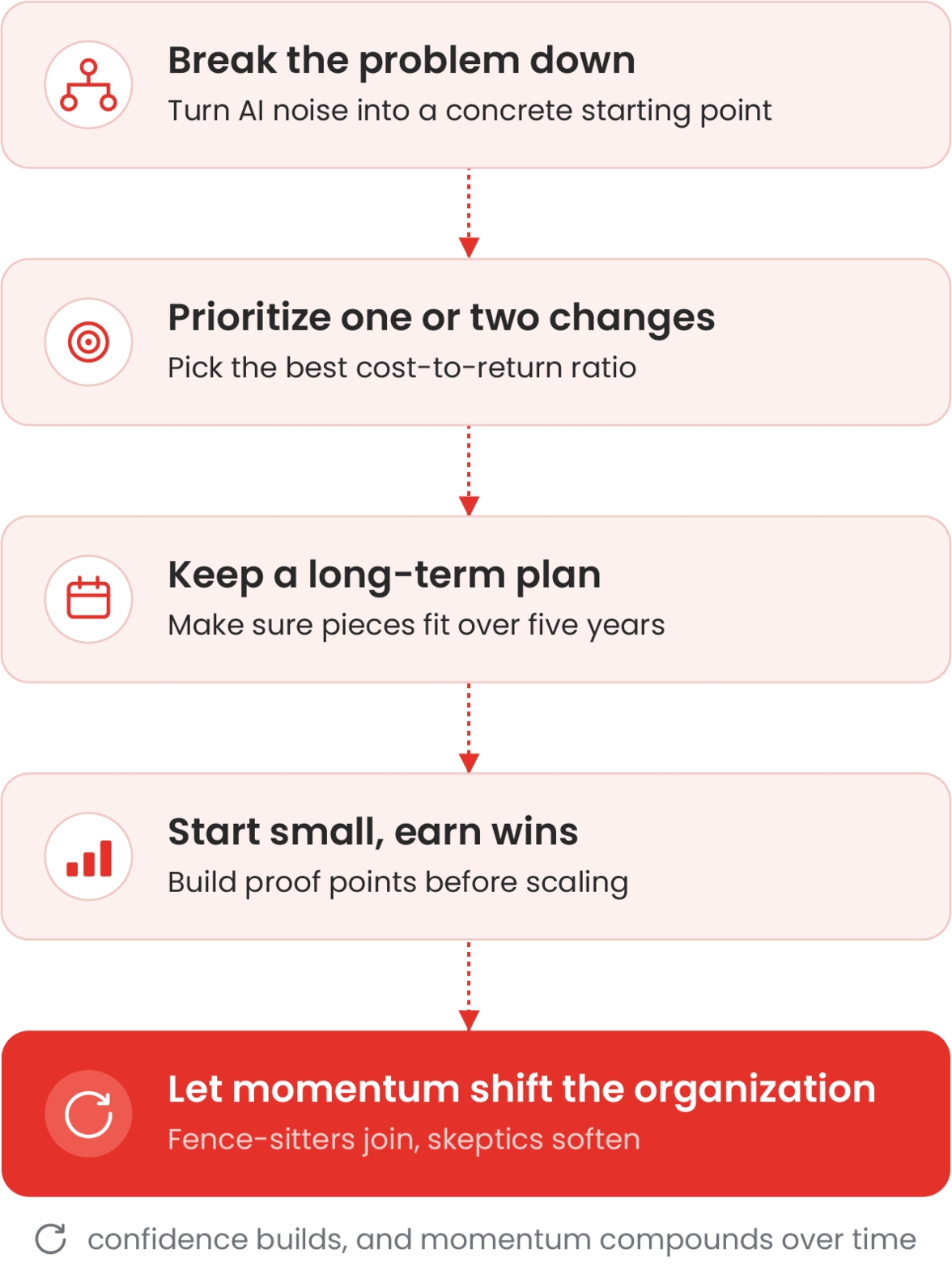
AI will continue expanding what is possible in physical retail. But lasting advantage will come from combining digital intelligence with connected data, strong execution, retailer alignment, and human collaboration. That is how physical retail becomes more responsive, more precise, and ultimately more capable of delivering the experiences consumers expect.
You can listen to the full episode on [Apple Podcasts](https://podcasts.apple.com/us/podcast/the-new-media-to-shelf-how-wired-cpg-wins-in-the-age-of-ai/id1834358230?i=1000772961529) and [Spotify](https://open.spotify.com/episode/2C97pkTkmBE1VZodlsfw9X).
[lc_the_tags]
## Suggested readings
[View all](/blogs/)
#### The Next CPG Flywheel: AI, Retail Media, and Rapid Innovation
[Read blog](/blogs/the-next-cpg-flywheel-ai-retail-media-and-rapid-innovation/)

#### Perfect Store Execution: Driving sales effectiveness with Generative AI-powered solutions on AWS
[Read blog](/blogs/perfect-store-execution-driving-sales-effectiveness-with-generative-ai-powered-solutions-on-aws/)

#### From concept to shelf – The AI advantage in CPG product innovation
[Read blog](/blogs/from-concept-to-shelf-the-ai-advantage-in-cpg-product-innovation/)
## Featured blogs
[lc_get_posts post_type="post"
posts_per_page="4" orderby="date" output_view="lc_get_posts_mycustom_view" output_number_of_columns="4"
output_wrapper_class="row" output_article_class="shadow" output_hide_elements="Excerpt"
output_excerpt_length="0" output_excerpt_text="Read More" output_heading_tag="span"
output_featured_image_format="thumbnail" output_featured_image_class="card-img-left" ]
## Share
[addtoany]
## Subscribe to get latest insights
## Talk to our experts
Get the best ROI with Sigmoid’s services in data engineering and AI
---
## Categories
- AI/ML
---
## Navigation
- [Company](/about-sigmoid)
- [Newsroom](/newsroom)
- [Life at Sigmoid](/careers)
- [Takshashila](/takshashila)
- [Contact Us](/contact-us)
- [AI Strategy Blueprint your AI advantage](/enterprise-ai-strategy/)
- [Generative AI Drive innovation with Generative AI](/generative-ai/)
- [Responsible AI Build trust with ethical AI practices](/responsible-ai-in-enterprise/)
- [Agentic AI Reshape business with scalable agentic systems](/agentic-ai-solutions/)
- [AI Managed Services Ensure reliable AI performance](/ai-managed-services/)
- [Advanced Analytics Transform your business with data-driven insights](/advanced-data-analytics-solutions/)
- [Download Whitepaper](/ebooks-whitepapers/the-new-qsr-playbook-transforming-menu-strategy-into-a-growth-engine/)
- [Data Strategy Strong data foundations for scalable AI](/data-analytics-strategy/)
- [Data Management Leverage data as a strategic asset](/ai-data-management-services/)
- [Data Ops Automate data for speed and quality](/data-devops/)
- [Data Engineering Deliver insights faster with scalable pipelines](/data-engineering/)
- [Cloud Transformation Modernize data to maximise efficiency](/cloud-migration/)
- [Download Whitepaper](/ebooks-whitepapers/building-data-products-in-a-data-mesh-to-drive-business-value/)
- [Data Modeling Structure data for better decisions](/data-modeling-services/)
- [Data Visualization Transform data into actionable stories](/data-visualization-service/)
- [BI Migration Enhance decision making with modern BI tools](/bi-migration/)
- [Data Observability Build trust with healthy, accurate data](/data-observability/)
- [Automated Insights Make smarter decisions with auto-generated insights](/automated-insights/)
- [Download Whitepaper](/ebooks-whitepapers/how-cognitive-bi-drives-an-intelligent-enterprise/)
- [CPG & Retail End-to-end analytics for planning, operations, and commercial excellence](/industries/cpg-analytics/)
- [Life Sciences Trusted intelligence across clinical, commercial, and operational workflows](/industries/life-sciences/)
- [Financial Services AI-powered analytics for risk, compliance and customer experience](/industries/banking-financial-analytics-services/)
- [Download Infographic](/wp-content/uploads/2026/03/Infographic_Maturity-Framework-for-Scaling-Agentic-AI.pdf)
- [MediaIQ Advanced platform for in-flight marketing measurement](/accelerators/sigmoid-mediaiq-multi-touch-attribution-tool/)
- [CampaignIQ AI-driven platform for optimized campaign budget allocation](/accelerators/sigmoid-campaigniq/)
- [AssistBot GenAI email assistant that automates human-like responses](/accelerators/sigmoid-assistbot-for-ai-email-assistant/)
- [CreativeBot GenAI tool for personalized and brand-aligned creative design](/accelerators/sigmoid-creativebot/)
- [SocialBot GenAI platform to analyze digital conversations and trends](/accelerators/#marketing|socialbot)
- [DemandIQ Predict trends accurately and optimize inventory management](/accelerators/sigmoid-demandiq/)
- [NetworkIQ Track and optimize logistics operations in real-time to quickly address disruptions](/accelerators/sigmoid-networkiq/)
- [SupplyIQ End-to-end platform to optimize supply chain operations](/accelerators/sigmoid-supplyiq/)
- [ProcurementIQ Automated procurement operations for maximum savings, compliance and efficiency](/accelerators/sigmoid-procurementiq/)
- [RapidML Accelerated deployment for machine learning models](/accelerators/sigmoid-rapidml/)
- [DataGuard Comprehensive platform for proactive data quality management](/accelerators/data-quality-tool-sigmoid-dataguard/)
- [CloudPulse Cloud cost optimization platform with multi-cloud management](/accelerators/sigmoid-cloudpulse/)
- [RAPID GenAI foundation with built-in governance and cost clarity](/accelerators/sigmoid-rapid/)
- [AnalyticsBot GenAI based platform to streamline decision-making in analytics](/accelerators/sigmoid-analyticsbot/)
- [DataConnect Seamlessly ingest, integrate and harmonize data from diverse sources](/accelerators/sigmoid-dataconnect/)
- [Reconica AI-powered data harmonization and reconciliation engine](/accelerators/sigmoid-reconica/)
- [ConverseBot GenAI driven insights generation for automated insights from reports](/accelerators/#sales|conversebot)
- [iNRM Cross-lever revenue growth optimization platform](/accelerators/sigmoid-inrm/)
- [AssortmentIQ Optimize shelf layouts and assortment mix at scale with AI-based insights](/accelerators/sigmoid-assortmentiq/)
- [Read Whitepaper](/ebooks-whitepapers/building-agentic-ai-chatbots-for-business-process-transformation/)
- [Listen Podcast](/events/podcast/how-jack-in-the-box-is-redefining-personalization-and-supply-chain-with-ai/)
- [Blogs](/blogs/)
- [White Papers](/ebooks-whitepapers/)
- [Case Studies](/case-studies/)
- [Podcast](/events/podcast/#Podcasts)
- [Download Case Study](/case-studies/ai-based-dynamic-targeting-and-personalized-hcp-engagement-for-pharma-marketing/)
- [ConverseBot](/accelerators/#sales|conversebot/)
## Tags
- Advanced Analytics
- AI
- CPG
- Digital Transformation
- In-store Execution
- Retail Media
---
## Footer Links
- [Talk to our AI experts](/contact-us/)
- [AI Strategy](/enterprise-ai-strategy/)
- [Agentic AI](/agentic-ai-solutions/)
- [Generative AI](/generative-ai/)
- [AI Managed Services](/ai-managed-services/)
- [Responsible AI](/responsible-ai-in-enterprise/)
- [Advanced Analytics](/advanced-data-analytics-solutions/)
- [Data Strategy](/data-analytics-strategy//)
- [Data Engineering](/data-engineering/)
- [Data Management](/ai-data-management-services/)
- [Cloud Transformation](/cloud-transformation/)
- [Data Ops](/data-devops/)
- [Data Visualization](/data-visualization-service/)
- [Automated Insights](/automated-insights/)
- [BI Migration](/bi-migration/)
- [Data Modeling](/data-modeling-services/)
- [Data Observability](/data-observability/)
- [CPG & Retail](/industries/cpg-analytics/)
- [Financial Services](/industries/banking-financial-analytics-services/)
- [Life Sciences](/industries/life-sciences/)
- [Case Studies](/case-studies/)
- [Thought Leadership](/ebooks-whitepapers/)
- [Blogs](/blogs/)
- [Company](/about-sigmoid/)
- [Newsroom](/newsroom/)
- [Accelerators](/accelerators/)
- [Careers](/careers/)
- [Privacy Policy |](/privacy-policy/)
- [Cookie Policy](/cookie-policy/)