---
# Rewiring Revenue Growth Management: Why CPGs must move beyond siloed execution
**URL:** https://www.sigmoid.com/blogs/rewiring-revenue-growth-management-why-cpgs-must-move-beyond-siloed-execution/
Date: 2026-04-20
Author: Joha Momin
Post Type: post
Summary: Key takeaways Siloed execution across pricing, promotions, assortment and trade investments is limiting RGM impact despite advanced analytics Fragmented data and disconnected...Read More...
Categories: AI/ML
Tags: AI, Commercial Analytics, Data Foundation, Portfolio Optimization, Pricing, Promotions, RGM, Trade Spend
Featured Image: https://www.sigmoid.com/wp-content/uploads/2026/04/Rewiring-Revenue-Growth-Management-New.jpg
---
## Key takeaways
- Siloed execution across pricing, promotions, assortment and trade investments is limiting RGM impact despite advanced analytics
- Fragmented data and disconnected decision-making create inefficiencies that restrict growth and profitability
- Integrated RGM enables cross-lever optimization, building synergies in commercial decisions across SKUs, channels, and retailers
- Leading CPGs are operationalizing RGM through unified platforms, harmonized data, and scenario planning
- The future of RGM lies in synchronized execution, not isolated optimization
Most CPG leaders today face a persistent paradox: their organizations have more RGM data, tools, and analytics than ever before, yet growth outcomes remain inconsistent. The issue is rarely the sophistication of the analytics; it lies in how commercial decisions are executed. When pricing, promotions, portfolio strategy, and trade investments are optimized independently, the result is fragmented execution and missed growth opportunities.
RGM today sits at the centre of commercial strategy, shaping portfolio architecture, guiding retailer negotiations, and determining how brands balance growth with profitability. Yet, in many organizations, execution models have not kept pace with this expanded scope. RGM levers are still often managed by different teams, measured through different KPIs, and supported by disconnected tools and data sources. Each lever may be optimized effectively within its own domain, but without coordination, these decisions create structural inefficiencies.
As market volatility increases and competitive pressures intensify, this fragmented approach is becoming increasingly unsustainable. [Leading CPG organizations](/industries/cpg-analytics/) are recognizing that the next phase of RGM requires a shift from isolated optimization to ***integrated commercial orchestration.***
## The cost of fragmented RGM execution
Traditional RGM models often fall short due to structural gaps in how commercial decisions are managed. While individual growth levers may deliver incremental gains, the lack of coordination across pricing, promotions, pack-price architecture, and trade investments limits their combined impact.
This disconnect manifests in a few critical ways:
- Misaligned promo decisions: Promotional campaigns designed to drive volume can dilute price positioning, while portfolio expansion can increase cannibalization across SKUs, reducing overall growth and profitability.
- Inefficient trade investments: Trade funds are often allocated without clear visibility into promotional effectiveness or retailer-level ROI, leading to overspending on low-performing accounts and missed opportunities in strategic channels.
- Fragmented pricing and assortment decisions: Price changes executed in isolation from assortment strategy can distort the price ladder, create overlaps across SKUs, and weaken premiumization, leading to margin dilution and internal cannibalization.
- Uncoordinated channel and pricing strategies: Inconsistent pricing and promo intensity across channels can trigger channel conflict, drive unintended switching, and erode brand equity, ultimately impacting both volume quality and profitability.
Over time, this fragmented execution model creates inefficiencies that are difficult to diagnose but directly impact growth and profitability.
## The shift toward Integrated Revenue Growth Management
Integrated RGM addresses these gaps by connecting pricing, promotions, portfolio strategy, and trade investments within a unified decision framework. Rather than optimizing each lever independently, organizations evaluate how these variables interact and influence overall commercial outcomes. This approach enables teams to simulate cross-lever trade-offs and design cohesive strategies for every SKU, channel, and retailer.
At its core, integrated RGM is powered by three key capabilities:
Core capability
What it enables
Unified data foundation
A single, trusted view of commercial performance by [harmonizing internal and external data sources](/blogs/the-arms-race-in-rgm-why-ai-will-separate-winners-from-the-rest/), including POS data, shipment information, trade spend records, consumer panel data, and product master data into a consistent analytical layer.
Cross-lever analytics
Quantifies the true drivers of growth and profitability through advanced analytics such as price elasticity modeling, promotional effectiveness measurement, demand transferability analysis, pack-price architecture optimization, and trade fund allocation benchmarking.
Scenario simulation and optimization
The ability to simulate pricing strategies, promotional mechanics, [assortment changes](/case-studies/category-assortment-optimization-with-planogram-drives-higher-retail-sales/), and trade investments in one environment and identify decisions that maximize revenue, margin, and market share under real-world constraints.
Multi-functional team and Change Management
Mobilize cross-functional teams to drive integrated decision-making and execution of iRGM. Accelerate change through value-led positioning, stakeholder socialization, and alignment on common objectives.
### Making integrated RGM work at scale: From vision to execution
While the strategic value of integrated RGM is clear, execution often falls short. The challenge is rarely defining the strategy, it is embedding it into everyday decision-making. Leading CPG companies are addressing this by adopting a unified platform that integrates all commercial levers within a common ecosystem. This allows teams to start with targeted use cases and scale towards full integration without disrupting existing workflows.
A key enabler is how data is operationalized. Instead of relying on separate data layers and offline preparation, teams can work with harmonized, decision-ready data directly within the planning environment. This significantly improves speed, consistency, and decision quality.
[Sigmoid’s iNRM platform](/accelerators/sigmoid-inrm/) follows this model through a **modular architecture**, where pricing, promotions, portfolio, and trade capabilities can be deployed independently or combined based on business needs. The platform integrates with existing systems, leveraging reusable analytical components while allowing flexibility in data models, workflows, and user interfaces. This balance of modularity and adaptability enables organizations to move from conceptual integration to practical, scalable execution, where insights consistently translate into action.
## How to translate RGM insights into a unified commercial execution cockpit?
Integrated RGM changes how commercial decisions are made. Commercial leaders gain access to a unified decision cockpit that brings pricing, promotions, portfolio strategy, and trade investment planning into a single environment.
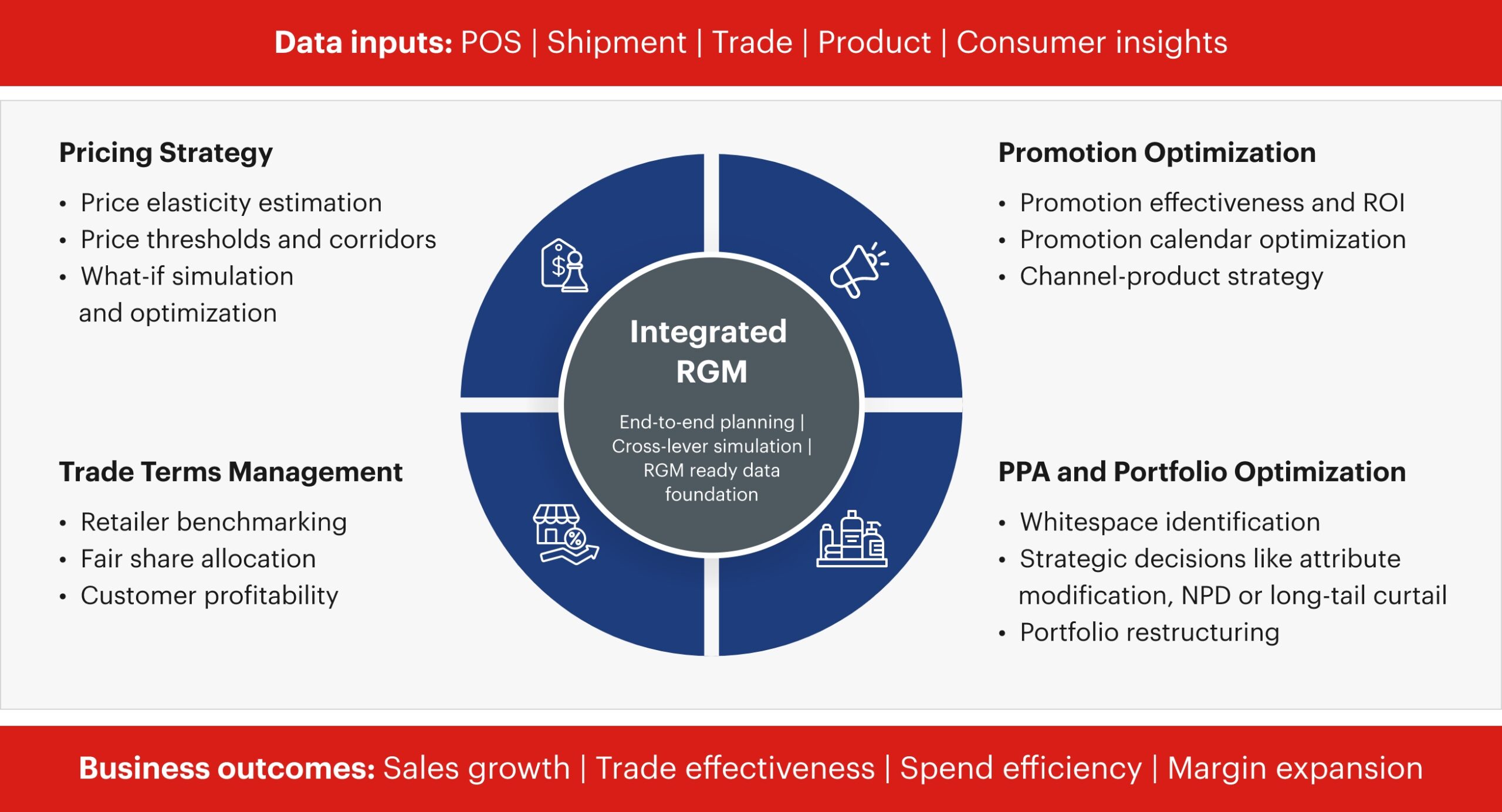
This enables more precise and aligned decision-making.
- Portfolio rationalization incorporates demand transferability to minimize cannibalization.
- Promotional calendars are optimized for incremental impact without eroding price perception.
- Trade investments are aligned with retailer performance and promotional ROI.
- Pricing strategies are calibrated to support both competitiveness and premiumization.
When these levers are aligned, the impact is significant. Organizations can unlock improvements in promotional effectiveness, trade spend efficiency, and portfolio profitability. More importantly, they move from reactive decision-making to proactive growth strategies that anticipate market shifts.
## Integrated RGM as an operating model, not just an analytics layer
The real shift underway is not just analytical, it is operational. Integrated RGM forces a rethink of how commercial teams collaborate, how decisions are sequenced, and how trade-offs are evaluated in real time. It replaces fragmented decision-making with a system where every commercial lever is calibrated against a shared set of outcomes.
In an environment where margins are under pressure and growth is increasingly contested, incremental improvements within individual levers will not be enough. Competitive advantage will come from the ability to connect decisions across the entire commercial ecosystem and act on them faster than the market.
In the next article of this series, we will explore the organizational transformation required to operationalize integrated RGM and how companies can build the change management capabilities needed to embed these strategies across commercial teams.
## About the author
**Amit Gupta** is Head of Commercial Analytics at Sigmoid. With over 20 years of experience in commercial analytics and AI-led transformation, he helps global enterprises drive data-led marketing and growth strategies at scale. He specializes in pricing, promotions, and trade optimization, translating complex data into actionable business outcomes. Amit has led large-scale transformation programs and built analytics capabilities that accelerate decision-making, customer engagement, and revenue growth.
**Kumar Amaresh** is RGM practice lead at Sigmoid. With over 15 years of experience in commercial and sales analytics, he partners with leading CPG organizations to drive data and AI-led transformation. He specializes in RGM, marketing effectiveness, and customer lifecycle analytics, delivering impact across pricing, trade optimization, and route-to-market strategies. Kumar works closely with business leadership to design integrated RGM roadmaps that actually deliver measurable business impact.
[lc_the_tags]
## Suggested resources
[View all](/blogs/)

#### Supercharging field sales effectiveness with data and AI
[Read blog](/blogs/supercharging-field-sales-effectiveness-with-data-and-ai/)

#### The arms race in RGM: Why AI will separate winners from the rest
[Read blog](/blogs/the-arms-race-in-rgm-why-ai-will-separate-winners-from-the-rest/)
#### Integrated revenue growth management
[Watch video](https://www.youtube.com/watch?v=6DppeBGWcto)
## Featured blogs
[lc_get_posts post_type="post"
posts_per_page="4" orderby="date" output_view="lc_get_posts_mycustom_view" output_number_of_columns="4"
output_wrapper_class="row" output_article_class="shadow" output_hide_elements="Excerpt"
output_excerpt_length="0" output_excerpt_text="Read More" output_heading_tag="span"
output_featured_image_format="thumbnail" output_featured_image_class="card-img-left" ]
## Share
[addtoany]
## Subscribe to get latest insights
## Talk to our experts
Get the best ROI with Sigmoid’s services in data engineering and AI
---
## Categories
- AI/ML
---
## Navigation
- [Company](/about-sigmoid)
- [Newsroom](/newsroom)
- [Life at Sigmoid](/careers)
- [Takshashila](/takshashila)
- [Contact Us](/contact-us)
- [AI Strategy Blueprint your AI advantage](/enterprise-ai-strategy/)
- [Generative AI Drive innovation with Generative AI](/generative-ai/)
- [Responsible AI Build trust with ethical AI practices](/responsible-ai-in-enterprise/)
- [Agentic AI Reshape business with scalable agentic systems](/agentic-ai-solutions/)
- [AI Managed Services Ensure reliable AI performance](/ai-managed-services/)
- [Advanced Analytics Transform your business with data-driven insights](/advanced-data-analytics-solutions/)
- [Download whitepaper](/ebooks-whitepapers/the-new-qsr-playbook-transforming-menu-strategy-into-a-growth-engine/)
- [Data Strategy Strong data foundations for scalable AI](/data-analytics-strategy/)
- [Data Management Leverage data as a strategic asset](/ai-data-management-services/)
- [DataOps Automate data for speed and quality](/data-devops/)
- [Forward Deployed Engineering Scale enterprise AI with FDEs & specialized agents](/forward-deployed-engineering/)
- [Data Engineering Deliver insights faster with scalable pipelines](/data-engineering/)
- [Cloud Transformation Modernize data to maximise efficiency](/cloud-migration/)
- [Download whitepaper](/ebooks-whitepapers/building-data-products-in-a-data-mesh-to-drive-business-value/)
- [Data Modeling Structure data for better decisions](/data-modeling-services/)
- [Data Visualization Transform data into actionable stories](/data-visualization-service/)
- [BI Migration Enhance decision making with modern BI tools](/bi-migration/)
- [Data Observability Build trust with healthy, accurate data](/data-observability/)
- [Automated Insights Make smarter decisions with auto-generated insights](/automated-insights/)
- [Download whitepaper](/ebooks-whitepapers/how-cognitive-bi-drives-an-intelligent-enterprise/)
- [CPG & Retail End-to-end analytics for planning, operations, and commercial excellence](/industries/cpg-analytics/)
- [Life Sciences Trusted intelligence across clinical, commercial, and operational workflows](/industries/life-sciences/)
- [Banking & Financial Services AI-powered analytics for risk, compliance and customer experience](/industries/banking-financial-analytics-services/)
- [Insurance Modernize core insurance platforms and unlock new revenue streams with AI](/industries/insurance-reimagined-with-ai/)
- [Download infographic](/wp-content/uploads/2026/03/Infographic_Maturity-Framework-for-Scaling-Agentic-AI.pdf)
- [Helios Turn marketing data into measurable business outcomes](/marketing-suite-helios/)
- [Stratos AI-powered platform for resilient supply chains](/supply-chain-stratos/)
- [DataGuard Agentic AI platform for data quality and governance](/data-quality-dataguard/)
- [MediaIQ Advanced platform for in-flight marketing measurement](/accelerators/sigmoid-mediaiq-multi-touch-attribution-tool/)
- [CampaignIQ AI-driven platform for optimized campaign budget allocation](/accelerators/sigmoid-campaigniq/)
- [AssistBot GenAI email assistant that automates human-like responses](/accelerators/sigmoid-assistbot-for-ai-email-assistant/)
- [CreativeBot GenAI tool for personalized and brand-aligned creative design](/accelerators/sigmoid-creativebot/)
- [SocialBot GenAI platform to analyze digital conversations and trends](/accelerators/#marketing|socialbot)
- [DemandIQ Predict trends accurately and optimize inventory management](/accelerators/sigmoid-demandiq/)
- [NetworkIQ Track and optimize logistics operations in real-time to quickly address disruptions](/accelerators/sigmoid-networkiq/)
- [SupplyIQ End-to-end platform to optimize supply chain operations](/accelerators/sigmoid-supplyiq/)
- [ProcurementIQ Automated procurement operations for maximum savings, compliance and efficiency](/accelerators/sigmoid-procurementiq/)
- [RapidML Accelerated deployment for machine learning models](/accelerators/sigmoid-rapidml/)
- [DataGuard Comprehensive platform for proactive data quality management](/accelerators/data-quality-tool-sigmoid-dataguard/)
- [CloudPulse Cloud cost optimization platform with multi-cloud management](/accelerators/sigmoid-cloudpulse/)
- [RAPID GenAI foundation with built-in governance and cost clarity](/accelerators/sigmoid-rapid/)
- [AnalyticsBot Conversational analytics for faster business decisions](/accelerators/sigmoid-analyticsbot/)
- [DataConnect Seamlessly ingest, integrate and harmonize data from diverse sources](/accelerators/sigmoid-dataconnect/)
- [Reconica AI-powered data harmonization and reconciliation engine](/accelerators/sigmoid-reconica/)
- [ConverseBot GenAI driven insights generation for automated insights from reports](/accelerators/#sales|conversebot)
- [iNRM Cross-lever revenue growth optimization platform](/accelerators/sigmoid-inrm/)
- [AssortmentIQ Optimize shelf layouts and assortment mix at scale with AI-based insights](/accelerators/sigmoid-assortmentiq/)
- [Read whitepaper](/ebooks-whitepapers/building-agentic-ai-chatbots-for-business-process-transformation/)
- [Listen Podcast](/events/podcast/how-jack-in-the-box-is-redefining-personalization-and-supply-chain-with-ai/)
- [Blogs](/blogs/)
- [White Papers](/ebooks-whitepapers/)
- [Case Studies](/case-studies/)
- [Podcast](/events/podcast/#Podcasts)
- [Download case study](/case-studies/ai-based-dynamic-targeting-and-personalized-hcp-engagement-for-pharma-marketing/)
- [ConverseBot](/accelerators/#sales|conversebot/)
## Tags
- AI
- Commercial Analytics
- Data Foundation
- Portfolio Optimization
- Pricing
- Promotions
- RGM
- Trade Spend
---
## Footer Links
- [Talk to our AI experts](/contact-us/)
- [AI Strategy](/enterprise-ai-strategy/)
- [Agentic AI](/agentic-ai-solutions/)
- [Generative AI](/generative-ai/)
- [AI Managed Services](/ai-managed-services/)
- [Responsible AI](/responsible-ai-in-enterprise/)
- [Advanced Analytics](/advanced-data-analytics-solutions/)
- [Data Strategy](/data-analytics-strategy//)
- [Data Engineering](/data-engineering/)
- [Data Management](/ai-data-management-services/)
- [Cloud Transformation](/cloud-transformation/)
- [DataOps](/data-devops/)
- [Forward Deployed Engineering](/forward-deployed-engineering/)
- [Data Visualization](/data-visualization-service/)
- [Automated Insights](/automated-insights/)
- [BI Migration](/bi-migration/)
- [Data Modeling](/data-modeling-services/)
- [Data Observability](/data-observability/)
- [CPG & Retail](/industries/cpg-analytics/)
- [Life Sciences](/industries/life-sciences/)
- [Banking & Financial Services](/industries/banking-financial-analytics-services/)
- [Insurance](/industries/insurance-reimagined-with-ai/)
- [Case Studies](/case-studies/)
- [Thought Leadership](/ebooks-whitepapers/)
- [Blogs](/blogs/)
- [Helios](/marketing-suite-helios/)
- [Stratos](/supply-chain-stratos/)
- [DataGuard](/data-quality-dataguard/)
- [Company](/about-sigmoid/)
- [Newsroom](/newsroom/)
- [Accelerators](/accelerators/)
- [Careers](/careers/)
- [Privacy Policy |](/privacy-policy/)
- [Cookie Policy](/cookie-policy/)