---
# How to use MLOps for an effective AI strategy
**URL:** https://www.sigmoid.com/blogs/mlops-for-effective-ai-strategy/
Date: 2021-01-19
Author: Sigmoid
Post Type: post
Summary: 87% of machine learning projects fail to make it into production. Deploying ML models in business use cases involves working around several...Read More...
Categories: MLOps
Tags: AI/ML, Cloud Transformation, Data Management
Featured Image: https://www.sigmoid.com/wp-content/uploads/2023/11/How-to-use-MLOps-for-an-effective-AI-strategy-banner-opt.jpg
---
87% of machine learning projects fail to make it into production. [Deploying ML models](/machine-learning-operationalization-mlops/) in business use cases involves working around several data and engineering bottlenecks that impede the implementation process. In fact, ML teams spend a quarter of their time trying to develop the infrastructure needed for ML modeling.
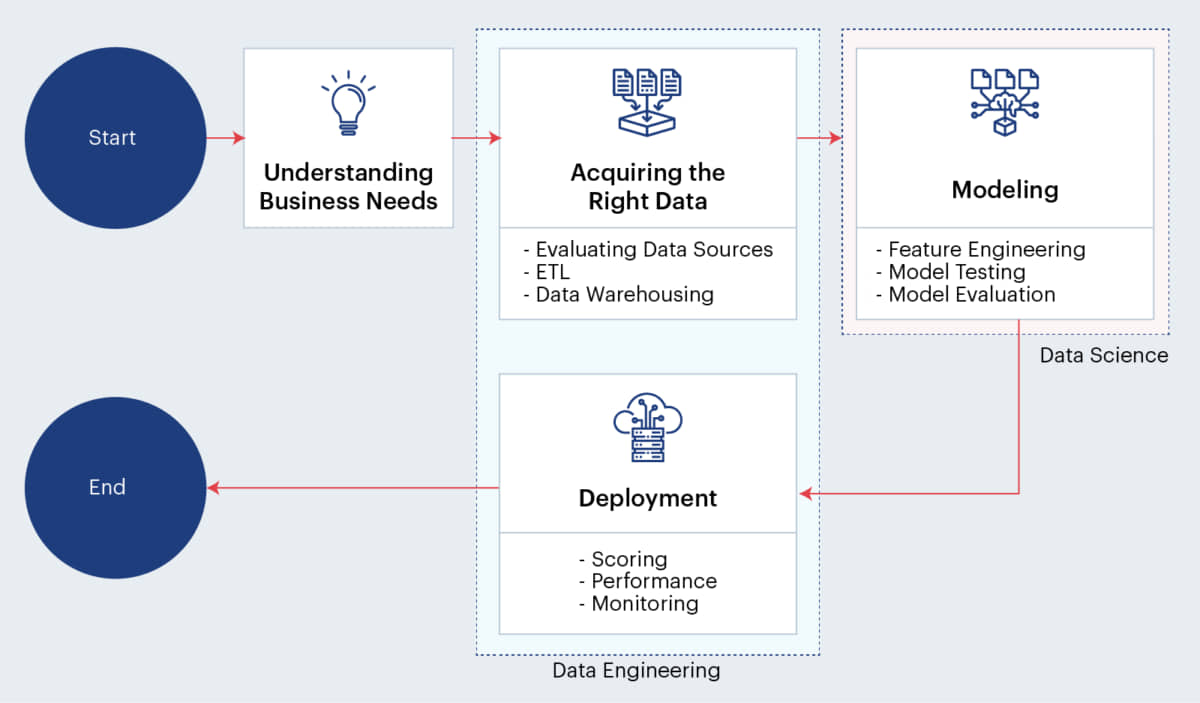
The Machine Learning Lifecycle
(Adapted from Microsoft’s – [Data Science Lifecycle](https://docs.microsoft.com/en-us/azure/machine-learning/team-data-science-process/media/lifecycle/tdsp-lifecycle2.png))
In one of our previous articles, we have [discussed in detail](/blogs/5-challenges-to-be-prepared-for-before-scaling-machine-learning-models/) the multiple reasons why such a high number of ML initiatives fail to make it to the production phase. The need to deal with these challenges and other smaller nuances of deploying ML models has given rise to the relatively new concept of [MLOps](/machine-learning-operationalization-mlops/).
## What is MLOps
MLOps – a set of best practices aimed at automating the ML lifecycle – brings together the ML system development and ML system operations. An amalgamation of DevOps, machine learning, and data engineering, [MLOps simplifies machine learning deployment](/machine-learning-operationalization-mlops/) issues in diverse business scenarios by establishing ML as an engineering discipline. It brings about several machine learning benefits to otherwise challenging scenarios of ML deployment.
Businesses can leverage MLOps to craft a definitive process for driving tangible outcomes through ML. One of the most prominent reasons behind the rising popularity of MLOps is its ability to bridge the expertise gap between business and data teams. Moreover, the wide-spread adoption of ML has had an impact on the evolution of the regulatory landscape. As this effect continues to grow, MLOps will help enterprises handle the bulk of regulatory compliance without impacting data practices.
And finally, the collaborative expertise between data and operations teams allows MLOps to bypass the bottlenecks that exist in the deployment process. And as we explore further, we will see how MLOps tightens the loop and irons out the creases in the machine learning system design and implementation framework.
## MLOps framework for success
Since MLOps is a nascent field, it can be difficult to get a grasp of what it entails and its requirements. One of the foremost challenges in implementing MLOps is the difficulty in superimposing DevOps practices on ML pipelines. This is primarily due to the fundamental difference: DevOps deals with code, whereas ML is code and data. And when it comes to data, unpredictability is always a major concern.
Since code and data evolve independently and in parallel, the resulting disconnect causes ML production models to be slow and often inconsistent. Moreover, applying a simple CI/CD approach may not be possible due to a lack of reproducibility of an immense volume of data which is difficult to track and version. Therefore, for machine learning in production, it is crucial to adopt a CI/CD/CT (continuous training) approach.
## Exploring the ML pipeline (CI/CD/CT)
Data teams need to look at MLOps simply as a code artefact that stands independent of individual data instances. This is why breaking it up into two distinct [pipelines](/events/cloud-webinar/) (training pipeline and serving pipeline) can help ensure a safe run environment for batch files as well as an effective test cycle.
The training pipeline involves the entire model preparation process which starts with collecting and preparing data. Once the data is collected, validated, and prepared, data scientists need to implement feature engineering to assign data values for training as well as in production. At the same time, an algorithm has to be chosen that will define how the model identifies data patterns. Once this is done, the model can start training based on historical offline data. The trained model can then be evaluated and validated before being deployed through a model registry to the production pipeline.
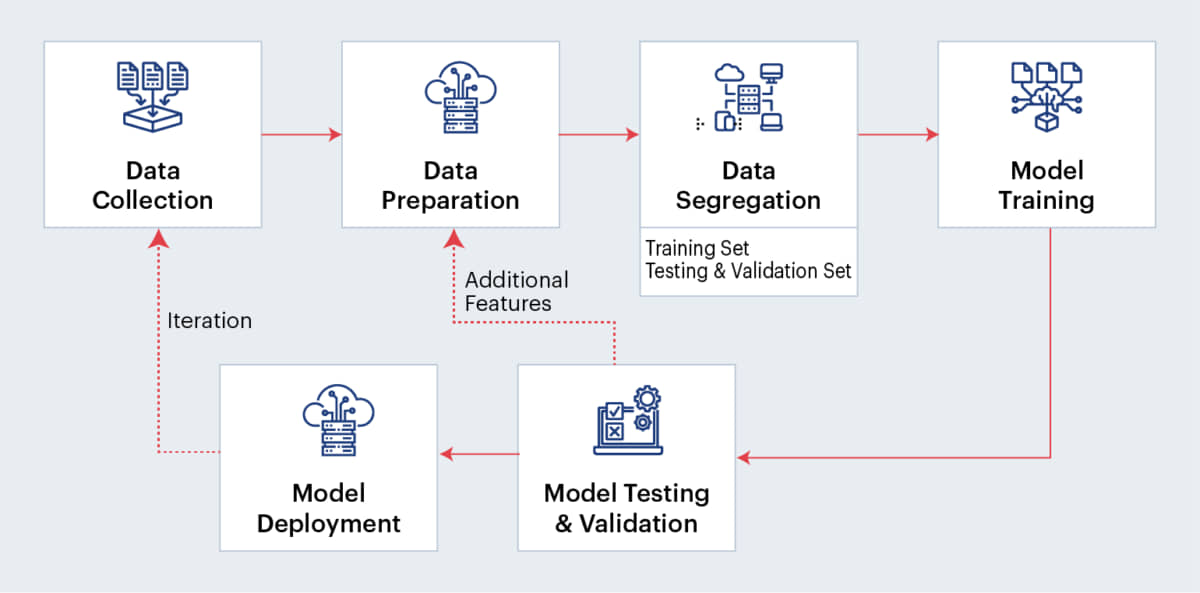
A schematic representation of the complete model preparation process
The production pipeline involves using the deployed model to generate predictions based on online or real-world data sets. This is where the CI/CD/CT approach comes to a full cycle through pipeline automation. The data is collected from the endpoint and enriched with additional data from the features store. This is followed by the automated process of data preparation, model training, evaluation, validation, and eventually generating predictions. Some of the components that fortify this automation process includes metadata management, pipeline trigger, feature store, and independent data and model versioning.
Once the model is deployed in the pipeline, the resulting data can then be used to continuously train models in the training pipeline. By doing so, it closes the data/code loops and simplifies the deployment process.
## Building the right team
The MLOps team should ideally include members from the operations, IT and data science division. An enterprise leader with experience in operationalizing machine learning should lead this team.
As far as aligning the team is concerned, MLOps teams can either be aligned with the enterprise architecture team under IT or it can also be integrated with the central analytics or data science team. Depending on the requirement, MLOps teams can work with specific business units together with [Data Science](/data-science-services/) or IT teams to manage complex models.
The MLOps team leaders need to clearly define roles for tasks such as data preparation, training ML models, deploying ML models and so on.
### Advantages of MLOps & the way forward
The foremost benefit of leveraging MLOps is the rapid, innovative ML lifecycle management. [MLOps solutions](/machine-learning-operationalization-mlops/) make it easier for data teams to collaborate with IT engineers and increase the speed of model development. Moreover, the provision to monitor, validate, and manage systems for machine learning models expedites the deployment process.
Besides saving time through rapid automated workflows, MLOps supports the optimization and reusability of resources. By leveraging MLOps, IT teams can create a self-learning model that can accommodate data drifts in the long run.
The quick rise of MLOps indicates a future where we will see it evolving into a competitive necessity. As machine learning benefits are explored in research as well as industry use cases, there is a need to keep at par with the agility of modern business models and adapt to changing circumstances. While that is still some way into the future, enterprises will need to act now to grab the opportunity when it arises.
Also, read our [blog](/blogs/5-best-practices-for-putting-ml-models-into-production/) on the 5 best practices to put ML models in production.
## About the author
Anwar is a business transformation manager at Sigmoid. For nearly a decade, he has led development and deployment of scalable AI solutions for clients in various industry domains helping them advance their analytics journey.
[lc_the_tags]
## Featured blogs
[lc_get_posts post_type="post"
posts_per_page="4" orderby="date" output_view="lc_get_posts_mycustom_view" output_number_of_columns="4"
output_wrapper_class="row" output_article_class="shadow" output_hide_elements="Excerpt"
output_excerpt_length="0" output_excerpt_text="Read More" output_heading_tag="span"
output_featured_image_format="thumbnail" output_featured_image_class="card-img-left" ]
## Share
[addtoany]
Subscribe to get latest insights
## Talk to our experts
Get the best ROI with Sigmoid’s services in data engineering and AI
## Suggested readings
[View all](/blogs/)

#### [Deploying Machine Learning Models with MLOps Automation](/blogs/deploying-machine-learning-models-with-mlops-automation/)
[Read blog](/blogs/deploying-machine-learning-models-with-mlops-automation/)

#### [How to Detect and Overcome Model Drift in MLOps](/blogs/how-to-detect-and-overcome-model-drift-in-mlops/)
[Read blog](/blogs/how-to-detect-and-overcome-model-drift-in-mlops/)

#### [The Transformative Role of Generative AI in Data Life Cycle Management](/blogs/the-transformative-role-of-generative-ai-in-data-life-cycle-management/)
[Read blog](/blogs/the-transformative-role-of-generative-ai-in-data-life-cycle-managemen)
---
## Categories
- MLOps
---
## Navigation
- [Company](/about-sigmoid)
- [Newsroom](/newsroom)
- [Life at Sigmoid](/careers)
- [Takshashila](/takshashila)
- [Contact Us](/contact-us)
- [AI Strategy Blueprint your AI advantage](/enterprise-ai-strategy/)
- [Generative AI Drive innovation with Generative AI](/generative-ai/)
- [Responsible AI Build trust with ethical AI practices](/responsible-ai-in-enterprise/)
- [Agentic AI Reshape business with scalable agentic systems](/agentic-ai-solutions/)
- [AI Managed Services Ensure reliable AI performance](/ai-managed-services/)
- [Advanced Analytics Transform your business with data-driven insights](/advanced-data-analytics-solutions/)
- [Download whitepaper](/ebooks-whitepapers/the-new-qsr-playbook-transforming-menu-strategy-into-a-growth-engine/)
- [Data Strategy Strong data foundations for scalable AI](/data-analytics-strategy/)
- [Data Management Leverage data as a strategic asset](/ai-data-management-services/)
- [DataOps Automate data for speed and quality](/data-devops/)
- [Forward Deployed Engineering Scale enterprise AI with FDEs & specialized agents](/forward-deployed-engineering/)
- [Data Engineering Deliver insights faster with scalable pipelines](/data-engineering/)
- [Cloud Transformation Modernize data to maximise efficiency](/cloud-migration/)
- [Download whitepaper](/ebooks-whitepapers/building-data-products-in-a-data-mesh-to-drive-business-value/)
- [Data Modeling Structure data for better decisions](/data-modeling-services/)
- [Data Visualization Transform data into actionable stories](/data-visualization-service/)
- [BI Migration Enhance decision making with modern BI tools](/bi-migration/)
- [Data Observability Build trust with healthy, accurate data](/data-observability/)
- [Automated Insights Make smarter decisions with auto-generated insights](/automated-insights/)
- [Download whitepaper](/ebooks-whitepapers/how-cognitive-bi-drives-an-intelligent-enterprise/)
- [CPG & Retail End-to-end analytics for planning, operations, and commercial excellence](/industries/cpg-analytics/)
- [Life Sciences Trusted intelligence across clinical, commercial, and operational workflows](/industries/life-sciences/)
- [Banking & Financial Services AI-powered analytics for risk, compliance and customer experience](/industries/banking-financial-analytics-services/)
- [Insurance Modernize core insurance platforms and unlock new revenue streams with AI](/industries/insurance-reimagined-with-ai/)
- [Download infographic](/wp-content/uploads/2026/03/Infographic_Maturity-Framework-for-Scaling-Agentic-AI.pdf)
- [Helios Turn marketing data into measurable business outcomes](/marketing-suite-helios/)
- [Stratos AI-powered platform for resilient supply chains](/supply-chain-stratos/)
- [DataGuard Agentic AI platform for data quality and governance](/data-quality-dataguard/)
- [MediaIQ Advanced platform for in-flight marketing measurement](/accelerators/sigmoid-mediaiq-multi-touch-attribution-tool/)
- [CampaignIQ AI-driven platform for optimized campaign budget allocation](/accelerators/sigmoid-campaigniq/)
- [AssistBot GenAI email assistant that automates human-like responses](/accelerators/sigmoid-assistbot-for-ai-email-assistant/)
- [CreativeBot GenAI tool for personalized and brand-aligned creative design](/accelerators/sigmoid-creativebot/)
- [SocialBot GenAI platform to analyze digital conversations and trends](/accelerators/#marketing|socialbot)
- [DemandIQ Predict trends accurately and optimize inventory management](/accelerators/sigmoid-demandiq/)
- [NetworkIQ Track and optimize logistics operations in real-time to quickly address disruptions](/accelerators/sigmoid-networkiq/)
- [SupplyIQ End-to-end platform to optimize supply chain operations](/accelerators/sigmoid-supplyiq/)
- [ProcurementIQ Automated procurement operations for maximum savings, compliance and efficiency](/accelerators/sigmoid-procurementiq/)
- [RapidML Accelerated deployment for machine learning models](/accelerators/sigmoid-rapidml/)
- [DataGuard Comprehensive platform for proactive data quality management](/accelerators/data-quality-tool-sigmoid-dataguard/)
- [CloudPulse Cloud cost optimization platform with multi-cloud management](/accelerators/sigmoid-cloudpulse/)
- [RAPID GenAI foundation with built-in governance and cost clarity](/accelerators/sigmoid-rapid/)
- [AnalyticsBot Conversational analytics for faster business decisions](/accelerators/sigmoid-analyticsbot/)
- [DataConnect Seamlessly ingest, integrate and harmonize data from diverse sources](/accelerators/sigmoid-dataconnect/)
- [Reconica AI-powered data harmonization and reconciliation engine](/accelerators/sigmoid-reconica/)
- [ConverseBot GenAI driven insights generation for automated insights from reports](/accelerators/#sales|conversebot)
- [iNRM Cross-lever revenue growth optimization platform](/accelerators/sigmoid-inrm/)
- [AssortmentIQ Optimize shelf layouts and assortment mix at scale with AI-based insights](/accelerators/sigmoid-assortmentiq/)
- [Read whitepaper](/ebooks-whitepapers/building-agentic-ai-chatbots-for-business-process-transformation/)
- [Listen Podcast](/events/podcast/how-jack-in-the-box-is-redefining-personalization-and-supply-chain-with-ai/)
- [Blogs](/blogs/)
- [White Papers](/ebooks-whitepapers/)
- [Case Studies](/case-studies/)
- [Podcast](/events/podcast/#Podcasts)
- [Download case study](/case-studies/ai-based-dynamic-targeting-and-personalized-hcp-engagement-for-pharma-marketing/)
- [ConverseBot](/accelerators/#sales|conversebot/)
## Tags
- AI/ML
- Cloud Transformation
- Data Management
---
## Footer Links
- [Talk to our AI experts](/contact-us/)
- [AI Strategy](/enterprise-ai-strategy/)
- [Agentic AI](/agentic-ai-solutions/)
- [Generative AI](/generative-ai/)
- [AI Managed Services](/ai-managed-services/)
- [Responsible AI](/responsible-ai-in-enterprise/)
- [Advanced Analytics](/advanced-data-analytics-solutions/)
- [Data Strategy](/data-analytics-strategy//)
- [Data Engineering](/data-engineering/)
- [Data Management](/ai-data-management-services/)
- [Cloud Transformation](/cloud-transformation/)
- [DataOps](/data-devops/)
- [Forward Deployed Engineering](/forward-deployed-engineering/)
- [Data Visualization](/data-visualization-service/)
- [Automated Insights](/automated-insights/)
- [BI Migration](/bi-migration/)
- [Data Modeling](/data-modeling-services/)
- [Data Observability](/data-observability/)
- [CPG & Retail](/industries/cpg-analytics/)
- [Life Sciences](/industries/life-sciences/)
- [Banking & Financial Services](/industries/banking-financial-analytics-services/)
- [Insurance](/industries/insurance-reimagined-with-ai/)
- [Case Studies](/case-studies/)
- [Thought Leadership](/ebooks-whitepapers/)
- [Blogs](/blogs/)
- [Helios](/marketing-suite-helios/)
- [Stratos](/supply-chain-stratos/)
- [DataGuard](/data-quality-dataguard/)
- [Company](/about-sigmoid/)
- [Newsroom](/newsroom/)
- [Accelerators](/accelerators/)
- [Careers](/careers/)
- [Privacy Policy |](/privacy-policy/)
- [Cookie Policy](/cookie-policy/)