

Why AI outcomes depend on getting the fundamentals right
Reading Time: 6 minutes
Key takeaways
- Successful AI adoption in CPG depends more on strong enterprise foundations than on advanced models.
- End-to-end visibility across data, processes, and decision-making is essential for scaling AI outcomes.
- Connected, high-quality data enables margin impact through use cases like optimization, scenario modeling, and dynamic pricing.
- Organizational alignment across technology, marketing, and finance functions is critical for scaling AI initiatives.
- Reliable demand signals and disciplined data governance remain central to effective forecasting and planning.
- Enterprises that strengthen data foundations and operating models will unlock the true value of AI.
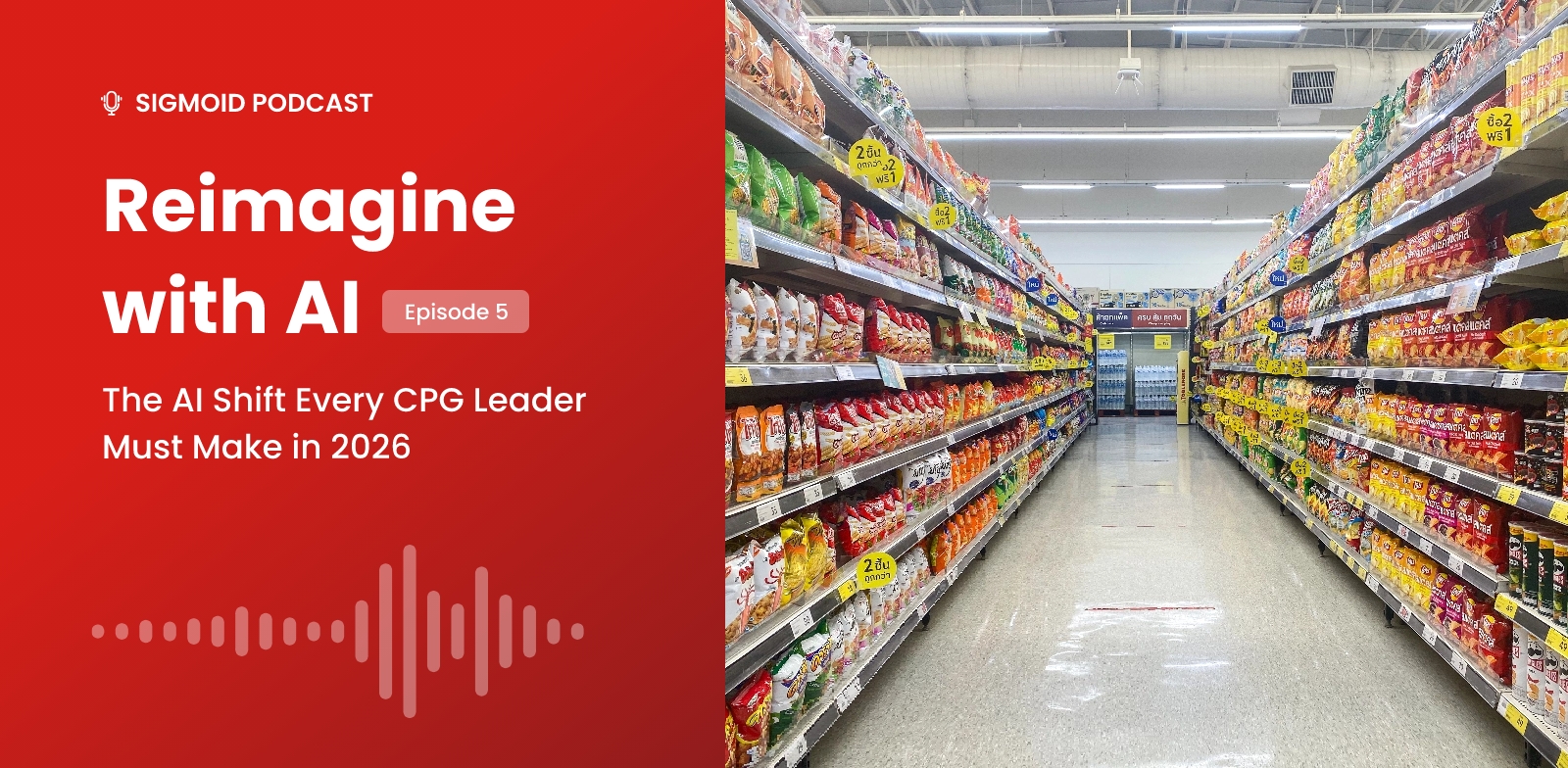
AI is reshaping how CPG organizations operate, forecast, and respond to volatility. But even as the industry accelerates adoption of GenAI, automation, and emerging agentic systems, outcomes are still being shaped by something more fundamental- the quality of enterprise foundations beneath the models.
In the latest episode of Reimagine with AI, the discussion explores why AI success is increasingly less about cutting-edge capability and more about end-to-end visibility, coherence, and trust in enterprise data.
This episode features Dan Wiseman, who leads data and analytics at Barry Callebaut, the world’s largest chocolate and ingredients manufacturer. With an operating footprint farmers, factories, formulations, and global B2B customers, the organization sits at the intersection of supply chain complexity, volatility and margin sensitivity.
Why does visibility comes before automation?
Rather than focusing on futuristic models, the discussion surfaces a more pragmatic truth: AI does not fix broken foundations. It amplifies whatever already exists. AI only creates impact once fundamentals are aligned. It becomes valuable when an organization has achieved coherence across data, processes, and decision-making across teams.
Volatility accelerates this need. Every silo, every spreadsheet dependency, and every fragmented forecast becomes visible. The organizations that perform best do not start by chasing moonshots. They start by seeing the business end-to-end. They work to connect data, processes, and decisions for automation to scale value rather than confusion.
Margin impact starts with connected data
Technology has historically delivered margin impact before revenue impact. AI follows the same pattern. Optimization, dynamic pricing, and what-if scenario modeling can move the P&L quickly, but only when the underlying data is high-quality, connected, and trustworthy.
What has changed is pace. Computing power has caught up with the amount of data CPG organizations generate, enabling decisions that once required dozens of analysts to run continuously in the background.
However, this advantage breaks down when core operational systems remain fragmented. If the supply chain is still running on legacy mainframes, spreadsheet-based workflows, and inconsistent forecasts, AI does not close gaps. It makes the gaps more visible, more quickly.
Why can’t platforms create transformation?
When cocoa prices surged 50% and stayed high for 18 months, Barry Callebaut had to widen its aperture. Procurement, operations, customer teams, and finance needed a unified view of demand, inventory, and margin.
What this revealed was less about the choice of technology and more about visibility. Transformation did not hinge on adopting another platform, but on whether the organization could connect data end-to-end across the value chain.
The implication is straightforward:
- Investment in end-to-end data is highly essential
- Monolithic platforms that promise transformation often introduce rigidity rather than agility
- True value comes from visibility across the entire chain, from farm to factory to customer
Once that backbone exists, AI becomes a force multiplier of faster and more confident decisions instead of amplifying existing constraints.
B2B and CPG brands: Different growth levers, same advantage
While growth levers may differ with co-innovation and customer-specific formulations creating advantage in B2B, and personalization and consumer relevance drive performance in branded CPG. But the operating edge is built on the same underlying system.
This system typically includes:
- Deep data around the customer, enabling precision rather than averages
- The ability to personalize or co-create, based on contextual needs and constraints
- Technology that flexes with volatility rather than working against it
Whether the objective is optimizing formulation and texture for a B2B customer or tailoring a consumer-facing flavor profile, the value comes from precision and adaptability, not platforms alone.
Scaling AI requires operating model alignment
AI initiatives stall when ownership is fragmented. They scale when accountability is shared across the leadership triangle.
- The CIO owns infrastructure
- The CMO drives activation
- The CFO validates value
But all three share responsibility for data quality, trust in models, and clarity on outcomes. Many organizations over-invest in dashboards while under-investing in alignment. Alignment consistently outperforms tooling, especially when decisions need to move faster across functions.
Speed comes from removing friction, not adding tools
AI does not create speed on its own. Speed is created when organizations remove friction from decision-making. Multi-layer approvals remain one of the most common blockers, particularly in environments that claim to prioritize agility.
The alternative is not reduced control, but a different control mechanism. Guardrails create control and ethics, not permissions. Automated checks, risk thresholds, and policy-as-code are better aligned with high velocity decision-making than hierarchical approvals.
The point is clear: organizations cannot claim to want speed while approving low-value decisions through multiple layers of hierarchy.
Why reliable demand signals still matter
As AI expands into demand sensing and forecasting, not all signals perform equally. While signals like social sentiment and raw impressions may appear attractive, they often lack a clean signal-to-noise relationship in real-world use.
Signals that remain consistently reliable include:
- Industry volume shifts
- Category trend lines
- Weather anomalies for seasonal products
- Transactional demand patterns
These “old signals” still work as they tend to be grounded in how markets and consumers actually behave. AI makes them more actionable when connected across the value chain and embedded into decision cycles, rather than treating them as standalone indicators.
Why most enterprises are not ready for agents yet
Agentic AI continues to generate attention, but many organizations are still struggling with foundational AI because data, workflows, and systems remain brittle. In that context, agents do not solve the problem; they amplify the mess.
Organizations that follow a grounded path for disciplined execution can counter-balance hype-led adoption of Agentic AI:
- Map the processes before automating decisions
- Strengthen foundations across data quality, governance, and integration
- Pick one or two domains where outcomes can be measured clearly
- Start small with targeted use cases rather than broad rollouts
- Prove value through pilots and repeatable proof points
- Scale deliberately once workflows, trust, and adoption are in place
Technical debt and talent will define the next 12 months
As organizations push AI initiatives forward, the nature of technical debt is becoming a decisive factor in whether progress compounds or stalls. A clear distinction is emerging around technical debt, with meaningful implications at scale.
- Good debt buys learning. Thin-slice proofs of concept, APIs, and modular services allow teams to experiment, validate assumptions, and adjust course without long-term constraints. These choices preserve flexibility while reducing risk.
- Bad debt buys lock-in. Hard-coded logic, bespoke systems, and large, monolithic platform bets may deliver short-term progress, but they often introduce rigidity that limits future change and slows adaptation as requirements evolve.
These trade-offs matter even more under persistent talent constraints. While many organizations recognize the need to expand AI and data teams, fewer are able to acquire headcount at the pace required. As a result, targeted upskilling is becoming a primary lever.
Three upskilling priorities are proving decisive:
- Data storytelling, ensuring insights translate into decisions and action
- Prompt engineering, helping teams extract value from existing tools
- Domain depth, providing context that technology providers cannot replicate
Technology can scale instantly, but people can not. As a result, competitive advantage is increasingly shaped by how effectively organizations combine technical literacy with business intuition.
The implication for CPG transformation
The most important takeaway is also the simplest. AI does not transform companies on its own. People, incentives, data discipline, and organizational alignment drive transformation. AI only scales what already exists, whether that is clarity or chaos.
If an organization cannot align on a single demand signal, a single view of inventory, and a consistent margin baseline, no AI model will compensate for the gaps. If approvals slow decisions down, no agent will create speed. And if data remains fragmented, AI will only amplify fragmentation at scale.
Without alignment on a single demand signal, a single view of inventory, and a consistent margin baseline, AI cannot deliver enterprise impact. Without streamlined decision flows, agents cannot unlock speed. And without connected data, AI will scale inconsistency faster than it scales value.
But when architecture is clean, teams are aligned, and the culture prioritizes evidence over intuition, AI becomes a force multiplier across the value chain, from farm to factory to P&L. Organizations that get this right will not just weather volatility. They will use it to widen the gap.
You can listen to the entire podcast on Apple Podcasts and Spotify.



Featured blogs



Featured blogs